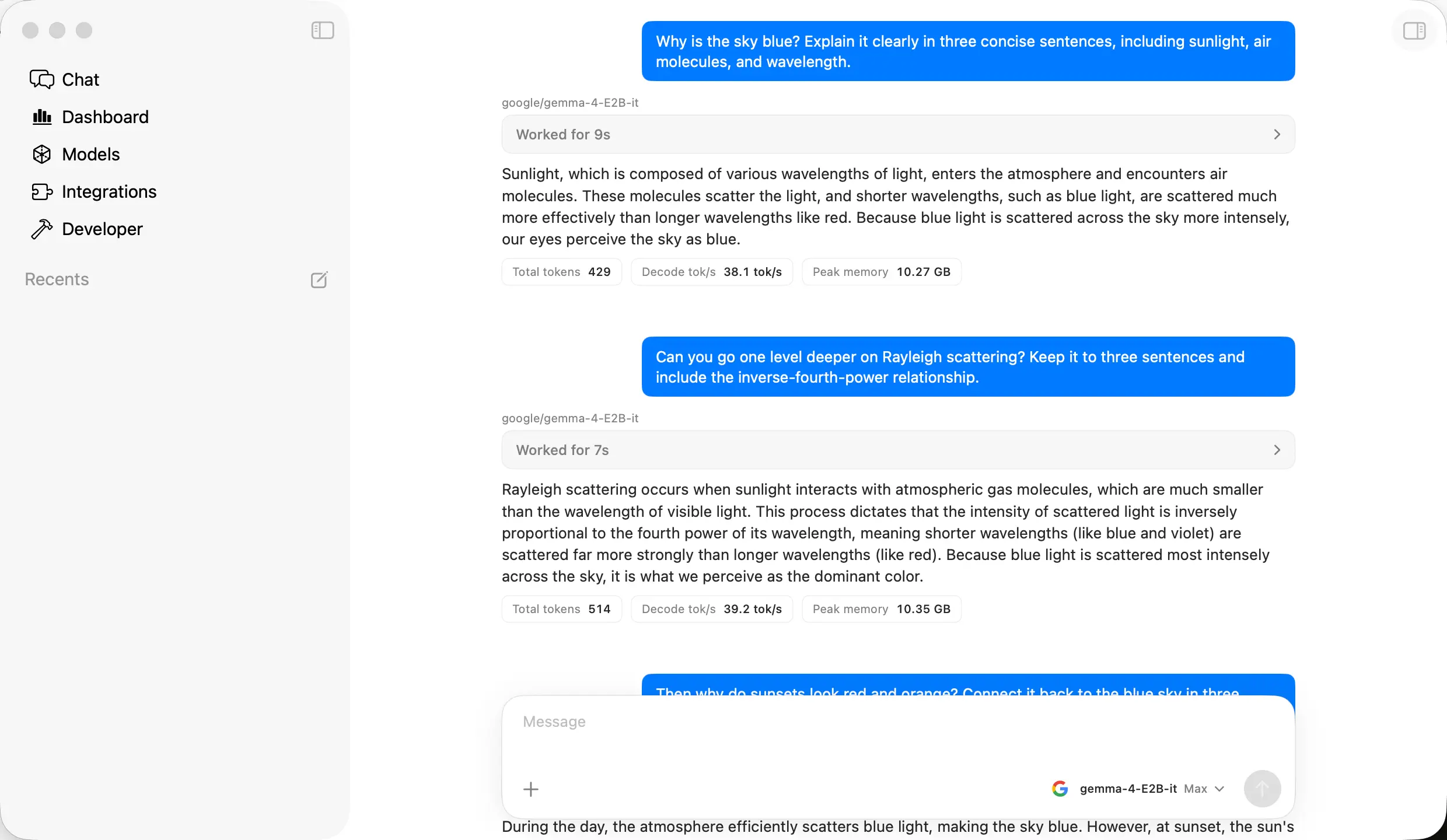
Nativ is a free, open-source macOS workspace for running MLX models locally on Apple silicon.
It combines private AI chat, local image generation and editing, model management, voice dictation, system monitoring, and localhost APIs in one native SwiftUI app.
The app bundles an mlx-vlm server and finds compatible models in the Hugging Face cache, including custom cache locations and MLX models installed by LM Studio. Nativ requires macOS 26 or newer.
You can chat with text and vision models, generate or edit images, dictate text into other Mac apps, or connect coding agents and editors to the local server.
Model inference stays on your Mac after each model has been downloaded.
It also comes with analytics and system views that report token use, time to first token, decode speed, CPU and GPU activity, unified memory and swap pressure, disk throughput, and recent requests.
Available unified memory determines which models and model combinations will fit.
Key Features
- Runs local text, vision, image, and speech models through MLX on Apple silicon.
- Streams chats with image attachments, reasoning output, response metrics, and persistent history.
- Organizes pinned chats and sessions in folders with drag-and-drop ordering and bulk actions.
- Accepts files dragged from Finder and images pasted into the chat composer.
- Generates and edits images locally with compatible MLX image models in the Images workspace and Chat.
- Collects images, videos, PDFs, Markdown files, and other outputs on the Artifacts page.
- Finds models in standard or custom Hugging Face caches and detects MLX models installed by LM Studio.
- Handles concurrent downloads, reports loading progress, and warns when a model or model combination exceeds available memory.
- Stores separate thinking and speculative-decoding settings for each model.
- Tracks request volume, token use, response latency, decode speed, CPU, GPU, memory, swap, and disk health.
- Exposes OpenAI-compatible chat, Responses, models, images, audio, and embeddings endpoints.
- Accepts Anthropic-compatible Messages and token-counting requests.
- Connects Codex, Claude Code, Pi, Hermes, OpenCode, Aider, Goose, Crush, Qwen Code, OpenClaw, and Open Interpreter to local models.
- Configures VS Code, Cursor, Zed, JetBrains, Cline, and Continue against the local server.
- Controls the server host, port, API key, loaded model, and live statistics from the app or menu bar.
- Installs, disables, removes, and restores independently versioned extensions.
- Provides local voice dictation, transcript history, recording shortcuts, and speech-model selection through the included Audio extension.
Nativ vs. LM Studio and Ollama
Nativ, LM Studio, and Ollama all run models locally and expose APIs for other applications.
Nativ vs. LM Studio
| Nativ | LM Studio | |
|---|---|---|
| UI | Native Mac workspace | Cross-platform desktop app |
| Model | MLX models on Apple silicon | GGUF models plus MLX on Apple silicon |
| Platform | macOS 26+, Apple silicon | macOS, Windows, Linux |
| workflows | Chat, images, dictation, monitoring, coding tools | Chat, documents, model library, local server |
| API | OpenAI and Anthropic formats | OpenAI and Anthropic formats |
Nativ vs. Ollama
| Nativ | Ollama | |
|---|---|---|
| UI | Native Mac workspace | Command-line runtime |
| Model | Hugging Face cache, MLX format | ollama pull model library |
| Platform | macOS 26+, Apple silicon | macOS, Windows, Linux |
| Workflows | Chat, images, dictation, monitoring, coding tools | Model serving and CLI operations |
| API | OpenAI and Anthropic formats | OpenAI and Anthropic formats |
Use Cases
Open a repository through Claude Code, Codex, Aider, or another listed coding agent, then select Nativ as the model endpoint. The coding agent handles files and terminal actions while requests go to the MLX model loaded on your Mac.
Generate an image in the Images workspace, edit an existing picture, or attach a screenshot, chart, interface mockup, or photograph to Chat. Compatible image and vision models process the request locally and place generated files in the app’s artifact library.
Hold the global dictation shortcut while working in another Mac app, release it to transcribe, and insert the result at the active cursor. Nativ uses an installed speech-to-text model and keeps a transcript history for later review.
Load compatible models in turn and run the same prompt through each one. Compare response speed, time to first token, token use, CPU and GPU activity, and memory pressure to find a model that fits your hardware.
Point an existing application at the local OpenAI- or Anthropic-compatible endpoint. You can test local chat, image, audio, embeddings, and model routes before changing a remote production service.
How to Use Nativ
1. Open the latest release page, download the DMG, and drag Nativ into the Applications folder.
2. Launch Nativ on an Apple silicon Mac running macOS 26 or newer. Choose an installed language model, download a recommended model, or continue with load-on-demand.
3. Open Models to select a compatible MLX model. Add a Hugging Face token in Settings if you need access to a gated model.
4. Open Chat, enter a prompt, and wait for the model to load. You can drag files from Finder or paste images into the composer when the selected model accepts them.
5. Open Images to generate or edit a picture with a compatible image model.
6. Grant Microphone and Accessibility permissions before using global dictation. Hold Fn + Control to record, then release the keys to transcribe and insert the text. Press Fn + R to transcribe the newest available recording again.
7. Open Analytics and System Monitor to inspect inference speed, token use, CPU and GPU activity, memory pressure, and recent requests.
8. Open Developer to change the server host or port, copy endpoint addresses, and generate an API key. Nativ stores the key in the macOS Keychain.
9. Open Integrations to configure a coding agent or editor against the model served by Nativ.
The default server address is:
http://127.0.0.1:8080A basic chat-completions request looks like this:
curl http://127.0.0.1:8080/v1/chat/completions \
  -H 'Content-Type: application/json' \
  -d '{
    "model": "your-model-id",
    "messages": [
      {
        "role": "user",
        "content": "Explain the main modules in this project."
      }
    ],
    "stream": false
  }'
Add this header when the server API key is active:
-H 'Authorization: Bearer your-api-key'Pros
- Native SwiftUI Mac app
- Local text, image, and audio workflows
- Integrated MLX model management
- OpenAI- and Anthropic-compatible APIs
- Built-in coding-tool setup
- Built-in system telemetry
- Configurable local server
- MIT-licensed
- No account or subscription
Cons
- macOS 26 required
- Apple silicon only
- MLX-focused model compatibility
- Large local storage requirements
- Unified memory limits model size
Alternatives & Related Resources
- Osaurus: Free Local AI Agents for Mac
- LM Studio: Run Local LLMs on Windows, Mac, and Linux
- Claude Code Local: Run Claude Code With Local AI on Apple Silicon
- Wayland: Local-First AI Agent Command Center for Claude Code & Codex
- SmallCode: Fast, Free, Local AI Coding Agent for Small LLMs
- The Ultimate Claude Code Resource List 2026: Agents, Skills, Plugins & More
FAQs
Q: Does Nativ’s MIT license apply to downloaded AI models?
A: No. The MIT license applies to the Nativ application source code. Each downloaded model has its own license for redistribution, commercial use, attribution, and other terms.
Q: Does API compatibility make a local model behave like GPT or Claude?
A: No. API compatibility defines the request and response formats accepted by the server. Output quality, context handling, reasoning, tool use, and instruction following depend on the selected local model.
Q: Can I use Nativ’s server with other applications?
A: Yes. A client that accepts an OpenAI- or Anthropic-compatible base URL can connect to Nativ’s server. Check the client’s required endpoints because API compatibility does not guarantee every client feature.
Q: Does Nativ send prompts or recordings to the cloud?
A: Model inference and transcription run on your Mac. Model downloads use the network, and a source build also downloads its first set of dependencies. Voice recordings are stored as temporary WAV files and deleted after five minutes or when Nativ quits. Matching text transcripts remain available until you remove them.
Q: Do I need a Hugging Face account or token?
A: Public models do not require a Hugging Face token. Add a token in Nativ or set HF_TOKEN when a gated model requires authenticated access.
Last Updated: Aug 04, 2026