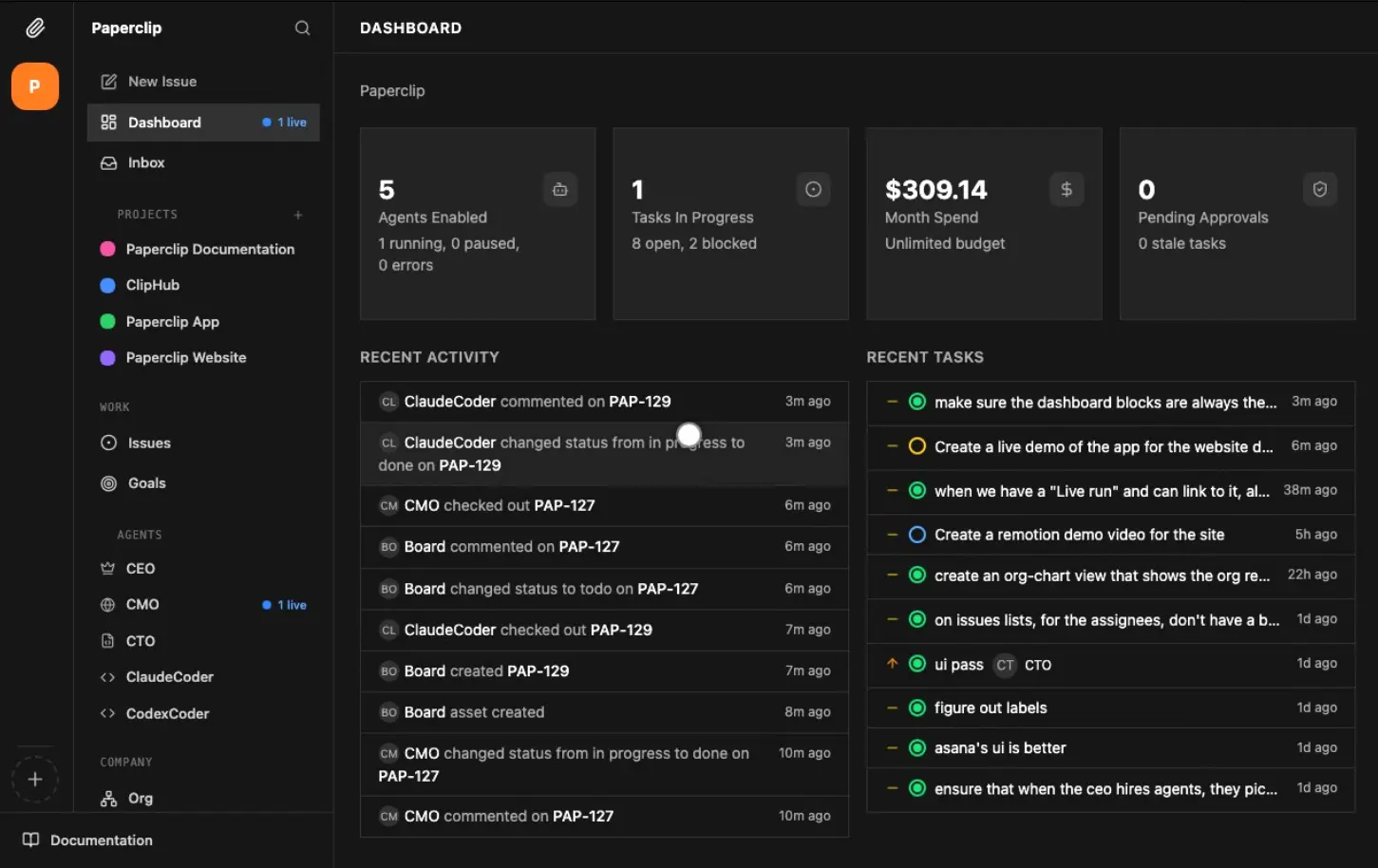
Paperclip is a free, open-source agent orchestration app for managing teams of AI agents from one dashboard.
It works across OpenClaw, Claude Code, Codex, Cursor, Bash, HTTP agents, and adapter-based local agents such as Gemini, OpenCode, Pi, Hermes, and Grok Build.
Paperclip treats agent work like company operations. You define a company goal, add agents with roles and budgets, assign work through issues, and use the dashboard to supervise execution, approvals, artifacts, costs, routines, and recovery.
Features
- Coordinates any AI agent that can receive a heartbeat.
- Tasks trace back to the company mission through projects, issues, and goal context.
- Agents wake on schedules, event triggers, task assignments, and mentions.
- Per-agent monthly budgets can pause work before agent runs create runaway token costs.
- Multiple companies can run from one deployment with company-scoped data isolation.
- Issue threads, documents, attachments, work products, and artifacts keep agent output visible in one place.
- The Skills Store lets you browse, install, and manage agent skills from the app.
- Company skills can be installed, reset, audited, exported, and assigned through CLI and board controls.
- Execution policies route work through review and approval stages before sensitive actions move forward.
- Sandbox providers can run agent execution in local, SSH-backed, cloud, or self-hosted Kubernetes environments.
- Plugins can extend Paperclip with host services, managed agents, managed routines, scoped APIs, and UI surfaces.
- The standalone MCP server exposes Paperclip API capabilities to MCP-compatible clients.
- Workspace file viewing and artifact links let you inspect files produced by agents from the issue thread.
- OpenTelemetry tracing can connect the server to an existing observability setup.
Use Cases
- Assign a product goal to several coding agents and track their issue progress from one dashboard.
- Schedule agent routines for customer support, content updates, report generation, QA checks, or operations work.
- Run separate companies, projects, or experiments from one Paperclip instance with isolated company data.
- Supervise multiple Claude Code, Codex, Cursor, Gemini, OpenCode, OpenClaw, or HTTP agents while Paperclip keeps cost and task context visible.
- Review files, documents, videos, and other artifacts that agents attach or create during work.
OpenClaw vs. Paperclip
OpenClaw is an autonomous worker for individual tasks. It can execute instructions, manage local files, and keep persistent memory for one agent workflow.
Paperclip sits above agents like OpenClaw. It coordinates teams, assigns roles, tracks costs, enforces approvals, records artifacts, and keeps agent work tied to company goals.
| OpenClaw | Paperclip | |
|---|---|---|
| What it is | Personal AI agent / single autonomous worker | Multi-agent orchestration app and control plane |
| Primary interface | Messaging apps such as WhatsApp, Telegram, and Discord | Web dashboard, mobile-ready UI, CLI, API, plugins, and MCP server |
| Agent support | Single agent per instance | Any heartbeat-compatible agent, such as OpenClaw, Claude Code, Codex, Cursor, Bash, HTTP, Gemini, OpenCode, Pi, Hermes, and Grok Build paths |
| Org structure | None | Org charts with roles, titles, permissions, budgets, and manager links |
| Goal alignment | No company goal hierarchy | Tasks trace through project and company goals |
| Budget control | None | Per-agent budgets, cost tracking, budget warnings, and hard stops |
| Work products | Conversation and file outputs depend on the agent setup | Company artifacts, issue documents, attachments, workspace files, and artifact links |
| Governance | Limited to the connected agent workflow | Board approvals, execution policies, review stages, pause, reassignment, and termination controls |
| Scheduled jobs | Heartbeat for a single agent | Routines, scheduled heartbeats, event triggers, webhooks, and API-triggered work |
| Multi-company | No | Yes, with company-scoped access and data isolation |
| Execution isolation | Depends on the agent runtime | Local, remote, cloud, and sandbox provider paths with self-hostable Kubernetes sandbox execution |
| Best for | Individual automation and personal agent tasks | Teams or operators that coordinate several autonomous AI work streams |
| License | MIT, self-hosted | MIT, self-hosted |
Installation
1. Install the Paperclip package and start the guided onboarding flow. The command sets up the local server, authentication path, embedded PostgreSQL database, and your first company.
npx paperclipai onboard --yes2. Use the public npm registry explicitly if a private registry in your global npm config causes an install error.
npm config get registry
npx --registry https://registry.npmjs.org paperclipai onboard --yes
3. Choose a bind preset for authenticated LAN or tailnet access. The default path uses local loopback.
npx paperclipai onboard --yes --bind lan
npx paperclipai onboard --yes --bind tailnet
4. Or install it manually from the GitHub repository.
git clone https://github.com/paperclipai/paperclip.git
cd paperclip
pnpm install
pnpm dev
5. The API server starts at http://localhost:3100.
Configuration Notes
Paperclip is self-hosted by default. A local setup can use embedded PostgreSQL and local file storage. A production setup should point the app at managed PostgreSQL, configure storage, define secrets, and review network exposure before connecting agents that can write files or run commands.
Telemetry is enabled by default and does not collect issue content, prompts, file paths, secrets, or personal information. You can turn it off with PAPERCLIP_TELEMETRY_DISABLED=1, DO_NOT_TRACK=1, CI=true, or telemetry.enabled: false in the config file.
Server tracing is optional. Set OTEL_EXPORTER_OTLP_ENDPOINT and the matching OTEL_EXPORTER_OTLP_PROTOCOL value when you want OpenTelemetry traces. Paperclip also accepts CIDR lists and named subnets through TRUST_PROXY for deployments behind proxies and load balancers.
The latest local adapter routing work affects codex, pi, opencode, and gemini. You can route those adapters through custom providers and gateways when your deployment uses its own model gateway or provider policy.
Setting Up a Company
1. Log in to the dashboard and create a company. Write a mission statement at the goal level, such as “Build the #1 AI note-taking app to $1M MRR.” Every task and agent decision traces back to that statement.
2. Add agents to the company. Assign each agent a role, manager link, job description, permission scope, and monthly budget.
3. Connect the agents you want Paperclip to supervise. You can bring local coding agents, HTTP agents, OpenClaw, Claude Code, Codex, Cursor, Gemini, OpenCode, Pi, Hermes, Grok Build, Bash scripts, or plugin-based adapters when your environment supports them.
4. Install reusable skills from the Skills Store or company skills catalog. Skills give agents task instructions, review rules, and workflow knowledge, so you do not have to hand-wire files for every agent.
5. Set the frequency at which each agent wakes and checks for work. Event-based triggers, task assignments, mentions, webhooks, API calls, and routines can wake agents outside a fixed schedule.
6. Assign a monthly token or cost budget to each agent. The system can warn at defined thresholds and pause work when the limit is reached. You can resume an agent manually when the extra spend is intentional.
7. Create a project under the company goal and add issues. Paperclip threads instructions and responses, records documents and attachments, links artifacts, and logs the activity trail for later review.
8. Configure execution policies when work needs approval. Review stages, board approvals, blocker dependencies, and document locks keep sensitive work parked until an approver clears it.
9. Select the right execution environment for each agent. Local workspaces are enough for simple setups. Remote or sandbox providers make more sense when agents need isolated filesystems, separate credentials, or cloud execution capacity.
Pros
- One dashboard for agent work.
- Strong budget controls.
- Company-scoped data isolation.
- Built-in skills management.
- Visible artifacts and work products.
- Self-hosted infrastructure control.
Cons
- Overkill for one agent.
- Setup requires runtime choices.
- Sandbox hosting needs infrastructure skill.
Related Resources
- Openclaw: Your 24/7 Personal AI Employee
- Hermes Agent: Free Self-Improving AI Agent
- 10 Best Agent Skills for Claude Code & AI Workflows
- 7 Best OpenClaw Alternatives for Safe & Local AI Agents
- Paperclip Docs
FAQs
Q: Is Paperclip free?
A: Paperclip is an open-source project under the MIT license. No Paperclip account is required for self-hosting. Your real cost comes from the infrastructure, model providers, agent runtimes, and sandbox services you connect to it.
Q: How is Paperclip different from just using Claude Code or OpenClaw directly?
A: Paperclip uses those agents as worker nodes. It adds the org chart, goal hierarchy, budget enforcement, heartbeat scheduling, company skills, artifacts, routines, and governance layer above them. A single Claude Code or OpenClaw session handles individual work. Paperclip handles assignment, cost, review state, and company context.
Q: Do I need to rewrite or reconfigure my existing agents?
A: No. Paperclip connects to agents through a heartbeat interface. Any agent that can receive a heartbeat can plug into the system. Adapters handle the connection between Paperclip and your execution environment.
Q: Which agents can Paperclip coordinate?
A: Paperclip is built around bring-your-own-agent orchestration. The project has paths for OpenClaw, Claude Code, Codex, Cursor, Bash, HTTP agents, Gemini, OpenCode, Pi, Hermes, Grok Build, ACPX, Cursor Cloud, and external adapter plugins. The exact setup depends on the adapter, credentials, runtime, and deployment mode you choose.
Q: Can I run more than one company from a single Paperclip install?
A: Yes. A single deployment can run multiple companies with company-scoped access and data isolation. That matters when you want separate ventures, teams, clients, experiments, or agent organizations in one control plane.
Q: Is there a hosted/cloud version?
A: Treat Paperclip as a self-hosted project. Recent versions add cloud and sandbox execution pieces with provider plugins and Kubernetes sandbox execution, but the dependable path is still your own instance with local, LAN, tailnet, remote, or production infrastructure.
Q: What database does Paperclip use?
A: Paperclip runs on PostgreSQL. The onboarding command can create an embedded PostgreSQL database for local use. Production deployments should use a managed PostgreSQL instance or a database setup you can back up and monitor.
Q: What should I check before connecting command-running agents?
A: Review each agent’s permissions, budget, model provider, workspace access, sandbox setting, secret access, and approval policy. Paperclip gives you governance controls, but a connected agent can still affect files, tools, and external services through its runtime.
Last Updated: June 22, 2026