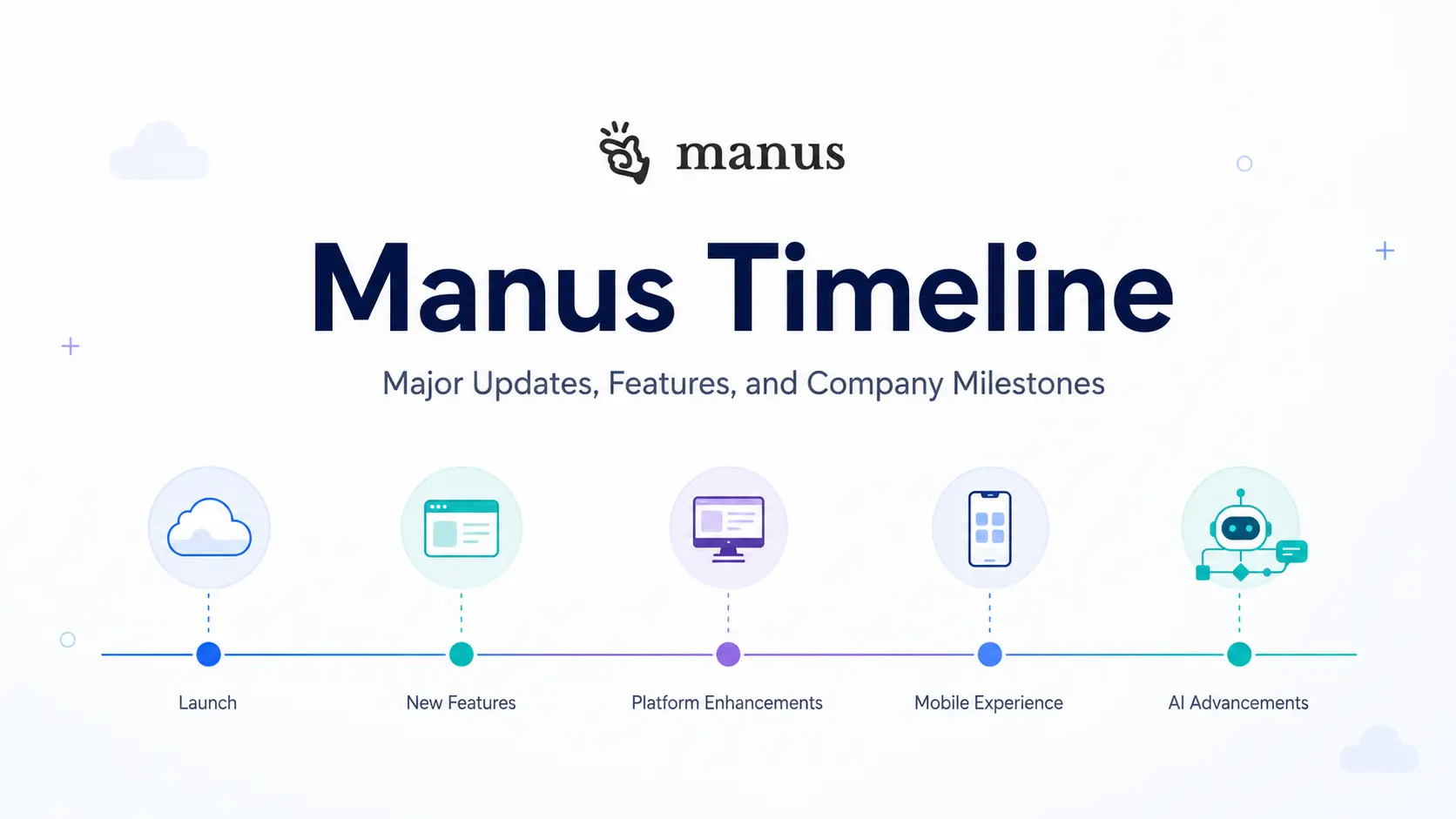
Manus launched on March 6, 2025 as an invite-only general-purpose AI agent that could research topics, run code, and create files inside a cloud computer.
Public registration opened on May 13, and the product expanded into parallel-agent research, persistent projects, local computer access, app building, and automation.
Its company history changed during that expansion. Manus announced a Meta transaction in December 2025, returned to independent operations on September 1, 2026, and released Manus 2.0 on September 28. Manus Flex followed as a beta option for using your own model API key.
The key dates below place those company events beside the releases that changed how Manus works.
Last updated: September 29, 2026.
Latest Manus update
Manus Flex entered beta on September 29, 2026. It lets you run Manus with an API key and model from a supported inference provider.
Manus 2.0 launched the day before Flex with Cascade, Manus Studio, event-triggered Automations, Video Editor, and Game Dev. Manus also introduced Cue, a separate app for personal agents. Manus 2.0 is available on the web, desktop, and mobile; Cue entered early access.
Manus AI release timeline
| Date | Milestone |
|---|---|
| September 29, 2026 | Manus Flex beta: an option to run Manus with your own model and API key from a supported inference provider. |
| September 28, 2026 | Manus 2.0 and Cue: Cascade, Manus Studio, event-triggered Automations, Video Editor, Game Dev, and the separate Cue app debuted. |
| September 1, 2026 | Independent operations resume: Manus formally returned to independent operations under its founding team. |
| August 11, 2026 | Return to independence announced: Manus announced the transition and a backup and restoration process for affected accounts. |
| July 22, 2026 | Plan Mode: Complex tasks gained a reviewable plan before execution. |
| July 14, 2026 | PowerPoint Slides: Manus began generating native, editable .pptx files. |
| July 13, 2026 | Auto-Publish: Successful WebDev builds could deploy automatically after opt-in. |
| July 9, 2026 | Branch: A task could split into parallel sessions that inherited earlier context. |
| June 24, 2026 | Hosting Modes: Built projects gained additional deployment infrastructure choices. |
| May 18, 2026 | Scheduled Tasks 2.0: Recurring work gained task history, Project context, and schedules for Manus-built web apps. |
| April 30, 2026 | Cloud Computer: Persistent Ubuntu machines retained files and ran services between tasks. |
| April 27, 2026 | Meta transaction challenged: China’s National Development and Reform Commission ordered the parties to withdraw the acquisition. |
| March 16, 2026 | My Computer: Manus Desktop gained access to approved local folders, command-line tools, and installed software. |
| February 16, 2026 | Manus Agents: Telegram became the first messaging channel for the full Manus agent. |
| January 27, 2026 | Agent Skills: Manus adopted reusable, file-based workflow packages. |
| December 29, 2025 | Meta transaction announced: Manus announced that it was joining Meta and said the standalone service would continue. |
| December 15, 2025 | Manus 1.6: Manus 1.6 Max, mobile app development, and Design View arrived. |
| December 1, 2025 | Projects: Persistent instructions, files, and knowledge became reusable across related tasks. |
| November 18, 2025 | Browser Operator: Manus gained access to approved local browser sessions. |
| October 16, 2025 | Manus 1.5: A rebuilt agent engine improved completion speed, reliability, and task quality. |
| July 31, 2025 | Wide Research: Multiple Manus agents could process large batches in parallel. |
| May 13, 2025 | Public registration: Manus removed its invitation waitlist and opened registration. |
| March 6, 2025 | Initial launch: Manus entered an invite-only public preview as a general-purpose AI agent. |
2025: Manus launches and opens to the public
March 6, 2025: Manus enters an invite-only preview
The Monica team introduced Manus as a general-purpose AI agent on March 6, 2025. A launch demonstration showed the system researching topics, comparing information, writing code, and assembling deliverables through a virtual computer. The work continued in the cloud after you left the session.
Access was limited. Prospective customers joined a waitlist or obtained invitation codes, and the scarcity became part of the launch attention. This was a closed public preview, not unrestricted general availability.
The company behind the release was widely identified as Butterfly Effect, the developer of Monica. Monica was already an AI assistant product. Manus became the company’s autonomous agent brand, which explains why early accounts used several company and product names.
May 13, 2025: public registration replaces invitation codes
Manus opened registration to the public on May 13, 2025. New accounts no longer needed a waitlist invitation. Free registration and daily use provisions created an entry point, and paid plans supplied more capacity and priority.
This access change is the clearest general-release boundary in the early history of Manus. The March debut established the product and its agent concept. The May opening gave the general public direct access.
July 31, 2025: Wide Research adds parallel agents
Wide Research changed how Manus handled large sets of similar items. The system divided a request into independent subtasks and assigned each one to a separate, full Manus instance. A main agent then collected and organized the results.
The design addressed a context limit problem. One agent processing a long list in sequence can lose detail as its working context fills. Independent contexts preserve room for each item. Common batch tasks include company research, product comparisons, paper reviews, data extraction, and content production. Wide Research became a paid-account capability that Manus can trigger for suitable tasks.
October 16, 2025: Manus 1.5 rebuilds the agent engine
Manus 1.5 was the first numbered release that materially reorganized the agent architecture. Manus reported that average completion time had fallen from about 15 minutes in April to just under four minutes by the release date. Its internal measurements also showed gains in task quality and customer satisfaction.
The release offered Manus-1.5 for maximum capability and Manus-1.5-Lite for lower-cost work. These names identify configurations of the complete agent system. They do not represent downloadable language models or a public family of model weights.
November 18, 2025: Browser Operator enters local sessions
Manus originally browsed through an isolated cloud environment. Browser Operator added a browser extension that worked inside your local browser, subject to the access you granted. This mattered for services that depend on an existing login, local session state, or interactive pages that reject cloud automation.
The extension created a second execution path. Cloud browsing handled remote work in an isolated environment. Browser Operator handled tasks tied to your browser identity, and you could observe or interrupt the operation.
December 1, 2025: Projects preserve instructions and knowledge
Projects introduced persistent workspaces for recurring tasks. Each Project held a master instruction, reference files, and a knowledge base that new sessions inherited. Related work could reuse those saved guidelines and files.
Projects were released across all subscription tiers and were private unless shared. Project members received the shared configuration. Individual task histories stayed under separate control.
December 15, 2025: Manus 1.6 adds Max and mobile development
Manus 1.6 introduced Manus 1.6 Max as the flagship agent configuration. The revised architecture focused on higher one-shot task success and greater autonomy during difficult work. Wide Research tasks under Max also used the newer agent architecture for their independent subtasks.
The release extended Manus beyond research and web output. Mobile Development generated phone apps. Design View supplied a workspace for image creation and editing.
December 29, 2025: Manus announces that it is joining Meta
Manus announced on December 29 that it was joining Meta. Meta said it planned to continue operating and selling the standalone Manus service and to use the team’s general-purpose agent technology across consumer and business products, including Meta AI.
Manus said its service and customer experience would continue. The company was based in Singapore, and its website and apps stayed active under the Manus brand. The ownership direction changed, and the standalone product continued operating.
2026: Manus expands across local, cloud, and application work
January 27, 2026: Manus adopts Agent Skills
Manus announced support for Agent Skills, a file-based standard for reusable instructions, scripts, references, and assets. A skill can teach the general agent a repeatable process. The complete procedure does not need to appear in every prompt.
The release included a way to package a successful Manus workflow as a skill and slash commands for selecting a named skill. Skills package reusable procedures. The Model Context Protocol connects agents to external services and data. Team libraries and deeper Project integration were roadmap items on the announcement date.
February 16, 2026: Manus Agents launches in Telegram
Manus Agents brought the complete agent into messaging applications, with Telegram as the first supported channel. Messages started multi-step tasks with the reasoning and tools used by the main service. The channel worked through a Manus account and did not require a separate bot server or API token.
The Telegram channel was available across subscription tiers. It gave you another way to reach Manus alongside the web and mobile apps. Completed work appeared in your Manus account.
March 16, 2026: My Computer reaches local files and tools
My Computer was the core feature of the new Manus Desktop application. It connected Manus to folders that you explicitly selected, then used local command-line tools to read and edit files, run software, and interact with the development environment.
Local execution used installed software and local hardware, including a compatible GPU. Manus required approval for commands and restricted file access to authorized folders. The desktop app supports Windows and Apple Silicon Macs. Linux is unsupported.
April 27, 2026: a regulator orders withdrawal of the Meta transaction
China’s National Development and Reform Commission said it had prohibited the foreign acquisition of Manus and required the parties to withdraw the transaction. The order followed scrutiny of the startup’s earlier Chinese operations and the transfer of AI technology and talent.
Meta responded that the transaction complied with applicable law and expected a resolution. The regulator and Meta therefore held conflicting public positions after the order. Manus later addressed the company’s direction in its August 11 announcement.
April 30, 2026: Cloud Computer adds a persistent environment
Cloud Computer introduced a dedicated Ubuntu virtual machine that stayed active between tasks. It hosted bots, kept databases and files, ran scheduled scripts, and operated services around the clock. You can reach the machine through a web terminal or SSH.
The persistent machine filled a gap between two existing environments. A temporary Manus sandbox suited finite cloud tasks, and My Computer used your physical machine. Cloud Computer supplied retained state and continuous uptime in an isolated remote system. Active plans and selected machine resources determined access and cost.
May 18, 2026: Scheduled Tasks 2.0 retains work context
Scheduled Tasks 2.0 expanded recurring automation beyond repeated standalone prompts. A run continued inside its task and reused the conversation, files, decisions, and earlier results. Schedules also inherited Project instructions, skills, and connectors.
Manus-built web apps gained scheduled actions for data refreshes, recurring reports, and other repeated jobs. Calendar and history views showed future and completed runs. The release was available across account tiers. Each schedule depended on the resources and connected services required by the task.
June 24, 2026: Hosting Modes expands deployment choices
Hosting Modes gave application builders a clearer choice between Manus-managed deployment and infrastructure matched to their own project requirements. The update addressed projects that needed more control over server location, capacity, or operations than the default website publishing path supplied.
This feature extended the application platform after Cloud Computer. Manus created an application, connected it to persistent services, and placed the deployed result in an environment selected for the workload.
July 9, 2026: Branch creates parallel task histories
Branch let you start a separate session from any earlier message. The new branch inherited the instructions, files, and history up to that point. The original conversation kept its own history, and later revisions stayed independent.
Session branching launched across account tiers in standard Manus chats. Web Builder sessions were excluded at release, which kept the feature focused on conversations and general tasks.
July 13, 2026: Auto-Publish connects successful builds to deployment
Auto-Publish added an optional switch to Manus WebDev projects. After you enabled it, each successful build deployed to the live URL. Failed or incomplete builds left the last stable version online.
The switch was off by default and under your control. It launched on the web, iOS, and Android across account tiers. Auto-Publish linked each successful edit to deployment after you enabled the switch.
July 14, 2026: Manus creates native PowerPoint files
PowerPoint Slides changed the format of Manus presentations. Earlier decks were created in a web format and converted during export. The new mode generated a native .pptx file from the start, with editable charts, structured table cells, and standard slide layouts.
You can download the file and continue editing it in Microsoft PowerPoint or Google Slides. Research, synthesis, image generation, and deck production occurred in one Manus task. The exported file preserved editable office-document structure.
July 22, 2026: Plan Mode adds approval before execution
Plan Mode inserted a deliberate review stage before Manus executed a complex request. The agent checked feasibility, identified missing requirements, and prepared a Markdown plan. You can edit that document directly or ask Manus to revise it, then confirm the result as the task’s working specification.
Manus did not begin the planned work until you confirmed or dismissed the plan. The mode also paused an active task and prepared the next phase. It launched across account tiers on web and mobile. You activated it manually. Short requests proceeded through the standard experience.
August 11, 2026: Manus announces a return to independent operation
Manus said it would return to independent operation after the regulatory dispute over its Meta transaction. The August 11 notice described the transition and confirmed that the service would continue.
Certain accounts required a backup during an August 23 to 24 data transition. Manus said the scheduled deletion was a regulatory measure, not a security incident.
September 1, 2026: Manus resumes independent operations
Manus confirmed that it had formally resumed independent operations, with its founding team continuing to lead the company. The announcement resolved the status left open by the August notice and the earlier Meta transaction.
If you backed up an affected account during the transition, you can restore it through the Manus restoration portal. Manus said there is no deadline to restore a backup. Accounts outside the affected group require no action.
September 28, 2026: Manus 2.0 introduces Cascade and Manus Studio
Manus 2.0 combined an updated agent architecture with new creation and automation features. Cascade, the latest version of Manus’s internal agent harness, adds specialized capabilities only when a project calls for them. A brief, website, video, and automation can stay in one connected project. In one tested configuration, Manus reported 23.2% lower token use, 28.2% less task time, and 32% lower running cost than its previous system. Those figures describe that test configuration, not every task.
The desktop app became Manus Studio. It handles documents, spreadsheets, PDFs, slides, websites, code, games, and video through project-specific workspaces. Video Editor exposes clips, images, text, motion graphics, and audio on an editable timeline. Alchemy mode generates a first cut that you can refine on that timeline. Game Dev uses generated art, video, and code with a live Edit panel for assets, code, movement, and scenes. Games can be published to the web, and multiplayer projects can use a purchased Cloud Computer as a persistent server.
Manus 2.0 also expanded automation and remote desktop work. A new email, calendar event, Slack message, or Notion update can trigger an Automation through a connected service. Remote Control lets you direct an authorized desktop session from your phone and watch Manus work. Computer Use operates in a visible workspace on your computer with access to approved files, the browser, and approved apps. Manus 2.0 launched on the web, desktop, and mobile.
September 28, 2026: Cue enters early access
Cue launched alongside Manus 2.0 as a separate app for personal agents built on Manus infrastructure. Each Cue agent has its own email address, phone number, wallet, and computer. An agent can send messages, take calls, make payments within a budget you set, and report back in Cue. Multiple agents can share a group chat and hand parts of a task to one another. You direct the work and make the final decision.
Cue entered free early access on the web, desktop, and mobile, with its iOS app awaiting App Store review at launch. The MEETCUE invitation code was available to a limited group on a first-come, first-served basis. Manus 2.0 was generally available.
September 29, 2026: Manus Flex adds a model choice
Manus Flex entered beta one day after Manus 2.0. It lets you connect an API key from a supported inference provider and choose a model to run within Manus. This adds a model choice to the agent experience while keeping the tasks in Manus.
Flex uses a provider key that you bring to Manus. That differs from the Manus API key used by developers to call Manus from another application. As a beta feature, Flex may produce different results with different models; confirm the available providers and current usage terms in Manus before relying on it for regular work.
Manus timeline FAQ
When did Manus AI launch?
Manus launched on March 6, 2025 as an invite-only public preview. The launch introduced the general-purpose agent and its cloud-computer workflow.
When did Manus open public registration?
Manus opened public registration on May 13, 2025. New accounts no longer needed an invitation code or waitlist approval.
When did Manus return to independent operations?
Manus announced its planned return to independence on August 11, 2026 and formally resumed independent operations on September 1, 2026.
What is the latest major Manus release?
Manus 2.0 is the latest major release as of September 30, 2026. It launched on September 28 with Cascade, Manus Studio, event-triggered Automations, Video Editor, Game Dev, and Remote Control. Cue entered early access the same day as a separate personal-agent app. Manus Flex followed in beta on September 29 with a model and API key option.
Related AI timelines
- AI Timelines: Model & Product Release History
- Meta AI Timeline: FAIR to Llama 4 and Muse AI
- Claude Timeline: Model Release Dates and Version History
- Codex Timeline: Release Dates and Major Updates