
The Artificial Intelligence field changes weekly. Algorithms that dominated in 2023 now serve only as historical footnotes. To succeed in 2026, you must understand Transformers, Large Language Models (LLMs), and Agents.
Many beginners assume this level of education requires an expensive university degree. That is false. Tech giants like Google, Microsoft, and NVIDIA are fighting a war for market share. They release premium education for free because they want you to build on their platforms.
Here is your definitive roadmap to learning AI in 2026.
1. AI for Beginners by Microsoft
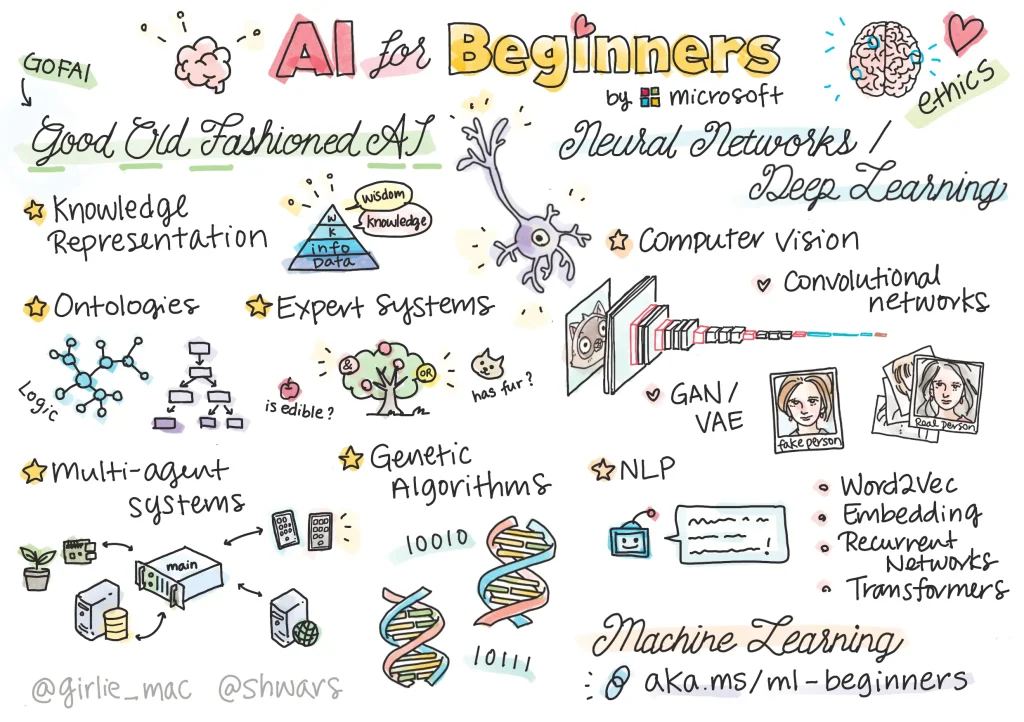
Microsoft publishes this curriculum on GitHub as open-source material. The course covers symbolic AI, neural networks, computer vision, natural language processing, and AI ethics across 24 lessons.
Syllabus Highlights:
- Neural Networks and Deep Learning Fundamentals
- Computer Vision with PyTorch and TensorFlow
- Natural Language Processing and text generation
- Reinforcement Learning and game AI
- Ethical AI and responsible development practices
Prerequisites:
- Basic Python programming (variables, loops, functions)
- No math background required (course introduces concepts as needed)
Free vs. Paid (The Catch):
- Completely Free. All 24 lessons, labs, and code examples live on GitHub. No hidden costs. No certificate upsell.
Best For:
- Developers who want a structured 12-week path
- Students who prefer hands-on labs over video lectures
- Anyone comfortable reading documentation and running code locally
Table Of Contents
- 2. Machine Learning Crash Course by Google
- 3. Introduction to Artificial Intelligence (AI) by IBM
- 4. Google AI Essentials by Google
- 5. Fundamentals of Machine Learning and Artificial Intelligence by AWS
- 6. Elements of AI by University of Helsinki & MinnaLearn
- 7. Generative AI Explained by NVIDIA
- 8. AI Agents Course by Hugging Face
- 9. Introduction to Machine Learning (6.036) by MIT
- 10. AI Fundamentals by IBM
2. Machine Learning Crash Course by Google
Google created this course for its own engineers. The company made it public in 2018 and updated it in 2024-2025 to include Large Language Models and modern best practices.
Syllabus Highlights:
- Linear and Logistic Regression with real datasets
- Neural Networks and Backpropagation
- Classification, Clustering, and Embeddings
- Large Language Models and prompt engineering
- Interactive visualizations for key concepts
Prerequisites:
- Basic algebra (understand what a function and variable mean)
- Python familiarity helps but the course teaches through examples
Free vs. Paid (The Catch):
- Completely Free. Google hosts all content on developers.google.com. No account required. No paywall.
Best For:
- Career switchers who want a fast-paced introduction
- Visual learners who benefit from animated explanations
- Engineers who prefer Google’s pedagogical style
3. Introduction to Artificial Intelligence (AI) by IBM
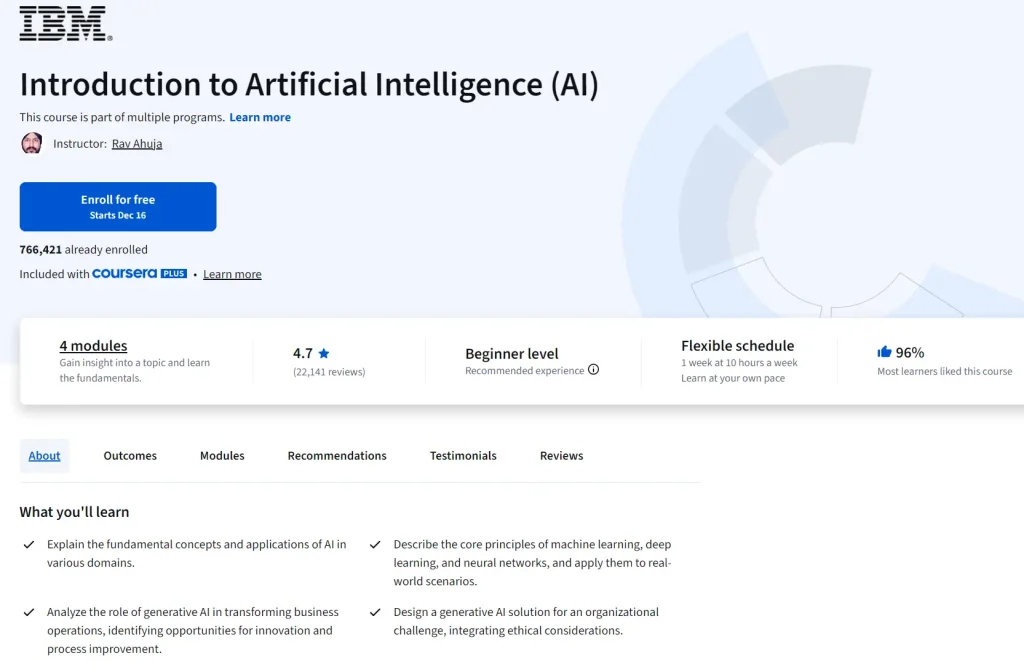
IBM structures this course around practical applications of AI in business and technology. The syllabus covers traditional ML, Deep Learning, and the 2023-2024 boom in Generative AI.
Syllabus Highlights:
- Core AI concepts (supervised vs. unsupervised learning)
- Machine Learning algorithms and use cases
- Deep Learning and neural network architectures
- Generative AI models (GPT, Stable Diffusion basics)
- Ethics in AI deployment
Prerequisites:
- None. The course assumes zero technical background.
Free vs. Paid (The Catch):
- Free to Audit. All video lectures and readings are free. Coursera requires payment ($49/month) for graded assignments and the shareable certificate.
- How to Audit: On the course page, look for “Audit this course” in small text near the enrollment button.
Best For:
- Complete beginners with no programming experience
- Business professionals who need AI literacy
- Students exploring AI before committing to a technical track
4. Google AI Essentials by Google
Google targets non-technical professionals with this short course. The focus sits squarely on Generative AI tools (ChatGPT, Bard, Gemini) and how to use them productively.
Syllabus Highlights:
- Fundamentals of Generative AI (what it is, how it works)
- Prompt Engineering techniques (zero-shot, few-shot, chain-of-thought)
- Using AI tools for writing, analysis, and productivity
- Responsible AI practices and bias awareness
Prerequisites:
- None. You need basic computer literacy (email, web browsing).
Free vs. Paid (The Catch):
- Free to Audit. All videos free. Certificate costs $49. Same Coursera audit process as IBM’s course.
Best For:
- Managers who need to understand AI capabilities
- Writers and marketers exploring AI tools
- Anyone wanting a sub-5-hour crash course
5. Fundamentals of Machine Learning and Artificial Intelligence by AWS

Amazon keeps this course short (1 hour). The content provides a high-altitude view of AI/ML concepts with examples from AWS services (SageMaker, Rekognition).
Syllabus Highlights:
- What is AI vs. ML vs. Deep Learning
- Use cases across industries (healthcare, finance, retail)
- Generative AI applications
- AWS service overview (not hands-on coding)
Prerequisites:
- None. The course avoids technical depth intentionally.
Free vs. Paid (The Catch):
- Completely Free. This is a free digital training module hosted directly on AWS Skill Builder. You need an Amazon account, but no credit card or Coursera subscription is required.
Best For:
- Decision-makers evaluating AWS for ML projects
- Students wanting a quick conceptual primer
- Anyone with 60 minutes to spare before deeper courses
6. Elements of AI by University of Helsinki & MinnaLearn
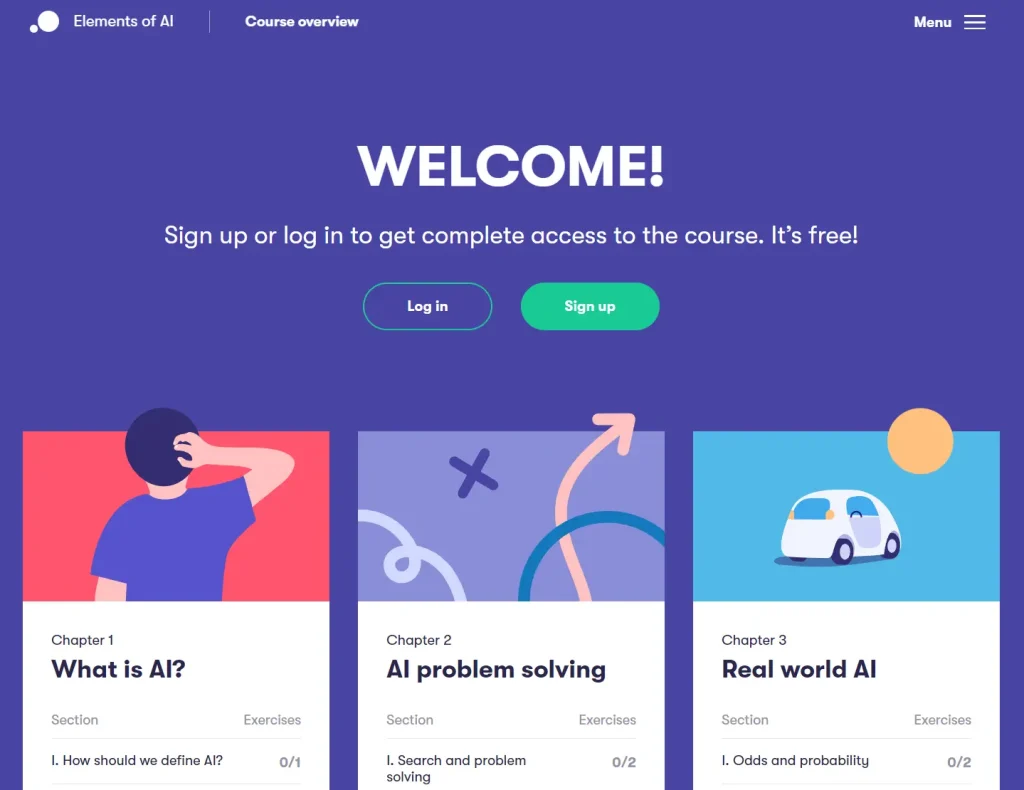
This course targets the general public. Finland’s University of Helsinki created it to educate citizens about AI. The course requires no programming and focuses on concepts, history, and societal impact.
Syllabus Highlights:
- What is AI? (History, definitions, capabilities)
- Problem-solving and search algorithms (conceptual)
- Real-world AI applications and limitations
- Societal and ethical implications
- Machine Learning basics (no code)
Prerequisites:
- None. High school math helps but the course explains everything from first principles.
Free vs. Paid (The Catch):
- Completely Free. In most countries, the certificate is also free. Some regions charge a small fee for the certificate.
Best For:
- Non-technical learners who want AI literacy
- Educators teaching AI to students
- Anyone intimidated by coding courses
7. Generative AI Explained by NVIDIA
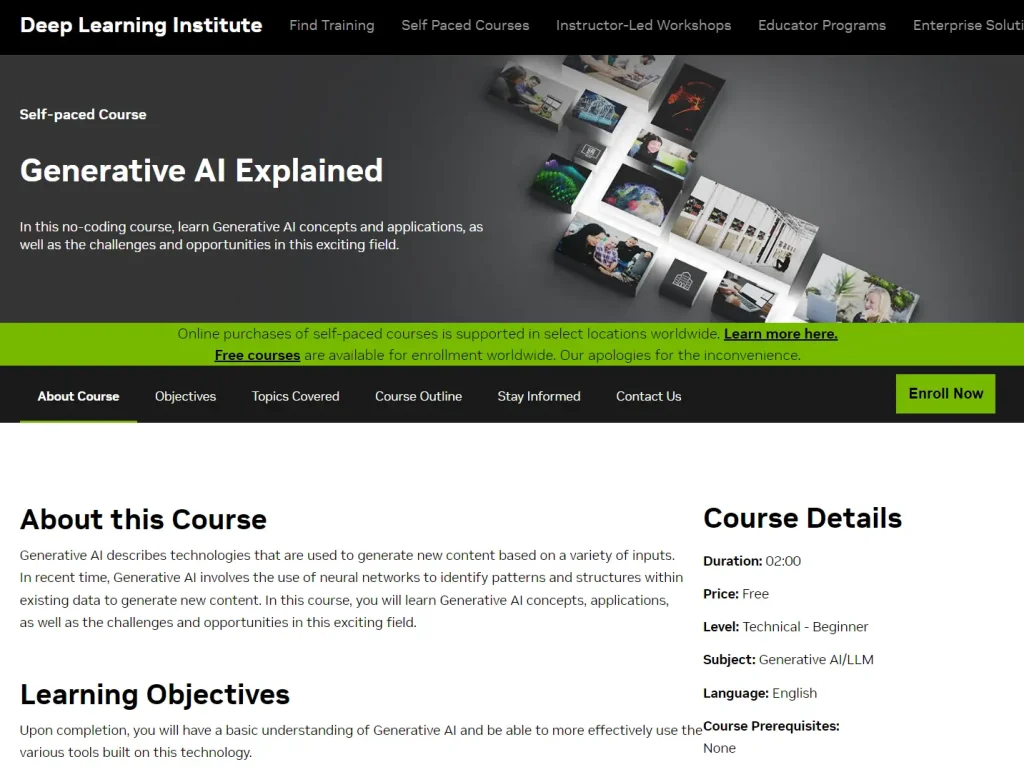
NVIDIA condenses Generative AI fundamentals into 2 hours. The course explains diffusion models, GANs, and transformer architectures without requiring you to code.
Syllabus Highlights:
- What is Generative AI? (vs. discriminative models)
- Transformer architecture basics
- Diffusion models (Stable Diffusion, DALL-E)
- Large Language Models (GPT family)
- Real-world applications
Prerequisites:
- Basic understanding of neural networks helps
- No coding required
Free vs. Paid (The Catch):
- Completely Free. NVIDIA’s Deep Learning Institute offers this as part of its free self-paced catalog.
Best For:
- Engineers wanting a quick GenAI primer
- Researchers exploring state-of-the-art models
- Anyone who reads “transformer” and wants to know what that means
8. AI Agents Course by Hugging Face
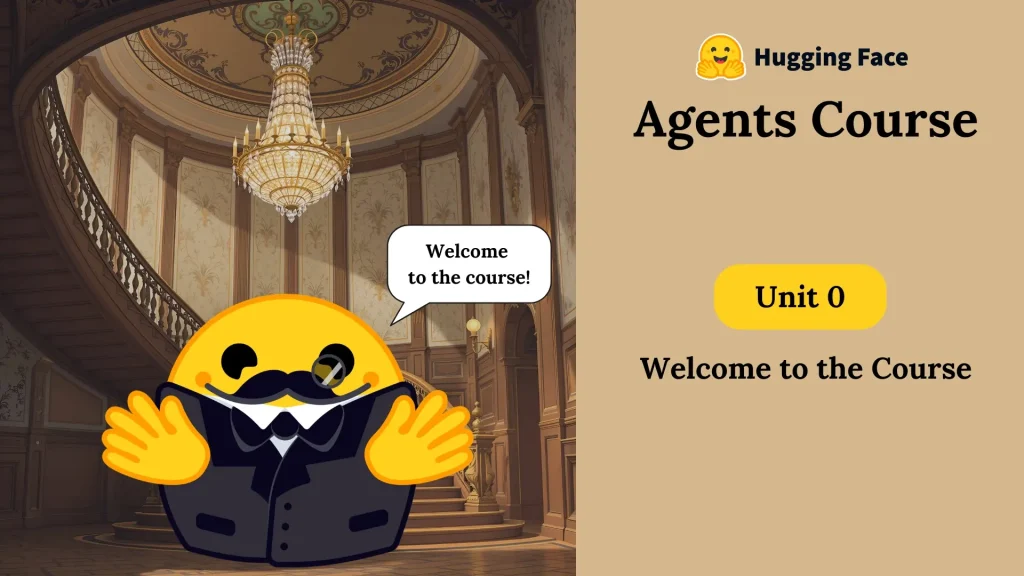
Hugging Face created this course to teach the most critical skill of 2026: Autonomous Agents. You will learn to build systems that can plan tasks, use tools, and execute complex workflows rather than just generate text.
Syllabus Highlights:
- Building Agents with smolagents
- Integrating LangGraph and LlamaIndex
- Creating Custom Tools and Planning
Prerequisites:
- Proficiency in Python and basic understanding of LLMs.
Free vs. Paid (The Catch):
- Completely Free. Hugging Face offers both the full curriculum and a verified certificate of completion at no cost.
Best For:
- Intermediate developers ready to move beyond simple chatbots.
9. Introduction to Machine Learning (6.036) by MIT

MIT’s undergraduate ML course demands more math than other entries on this list. The course covers supervised learning, unsupervised learning, and reinforcement learning with rigorous proofs and derivations.
Syllabus Highlights:
- Linear classifiers and perceptrons
- Neural Networks and backpropagation (mathematical derivation)
- Support Vector Machines
- Decision Trees and ensemble methods
- Reinforcement Learning (Q-learning, policy gradients)
Prerequisites:
- Python programming (NumPy proficiency)
- Calculus (derivatives, gradients, chain rule)
- Linear Algebra (matrices, eigenvalues)
Free vs. Paid (The Catch):
- Completely Free. All lectures, notes, and problem sets are on MIT Open Learning Library. No certificate available.
Best For:
- Computer Science students seeking depth
- Engineers who want to understand the math behind algorithms
- Anyone preparing for ML research or advanced roles
10. AI Fundamentals by IBM

IBM hosts this modular course on its SkillsBuild platform. The course covers ML, Deep Learning, NLP, and Computer Vision with IBM Watson Studio integrations.
Syllabus Highlights:
- Machine Learning basics and algorithms
- Deep Learning and neural networks
- Natural Language Processing (text analysis, chatbots)
- Computer Vision (image classification, object detection)
- Hands-on labs with IBM Watson Studio
Prerequisites:
- None for conceptual modules
- Python basics help for Watson Studio labs
Free vs. Paid (The Catch):
- Completely Free. IBM SkillsBuild offers free courses and digital badges. No hidden costs.
Best For:
- Students exploring IBM’s AI ecosystem
- Professionals seeking vendor-specific skills
- Anyone wanting modular, self-paced content
Comparison Table
| Course Name | Provider | Duration | Math Heavy? | Free Type |
|---|---|---|---|---|
| AI for Beginners | Microsoft | 12 weeks | No | Completely Free |
| ML Crash Course | 15 hours | Minimal | Completely Free | |
| Intro to AI | IBM | 11 hours | No | Free to Audit |
| AI Essentials | <5 hours | No | Free to Audit | |
| ML & AI Fundamentals | AWS | 1 hour | No | Free to Audit |
| Elements of AI | Helsinki | 30-50 hours | No | Completely Free |
| Generative AI Explained | NVIDIA | 2 hours | Minimal | Completely Free |
| Hugging Face AI Agents | Hugging Face | 15 hours | No | Completely Free |
| Intro to ML (6.036) | MIT | 13 weeks | Yes | Completely Free |
| AI Fundamentals | IBM | 10 hours | No | Completely Free |
Learning Path Guide: Which Course Should You Start With?
The Code-First Path (Best for Developers)
Start here: Microsoft’s AI for Beginners → Google’s ML Crash Course → MIT’s 6.036 (if you want depth)
Microsoft’s course throws you into Python code immediately. You build neural networks in Week 3. Google’s course reinforces those concepts with clearer explanations. MIT’s course gives you the math behind the magic.
Timeline: 16-28 weeks if you follow all three sequentially.
The Math-First Path (Best for Theory Lovers)
Start here: Elements of AI → MIT’s 6.036 → NVIDIA’s Generative AI Explained
Elements of AI gives you conceptual grounding without equations. MIT’s course delivers the calculus and linear algebra you need. NVIDIA’s course shows you how modern architectures (Transformers) apply that theory.
Timeline: 16-20 weeks. Prepare to work through problem sets.
The GenAI Fast Track (Best for 2026 Job Market)
Start here: Google AI Essentials → IBM’s Intro to AI → NVIDIA’s Generative AI Explained → Microsoft’s AI for Beginners (focus on NLP modules)
The 2026 job market wants engineers who understand prompt engineering, RAG systems, and fine-tuning. Google’s course teaches prompting. IBM’s course explains how GenAI fits into broader AI. NVIDIA’s course breaks down transformer architecture. Microsoft’s course gives you hands-on NLP projects.
Timeline: 10-14 weeks. This path prioritizes employable skills.
The Zero-to-Hero Path (Best for Complete Beginners)
Start here: Elements of AI → IBM’s Intro to AI → Google’s ML Crash Course → Microsoft’s AI for Beginners
Elements of AI removes intimidation. IBM’s course introduces terminology. Google’s course teaches core algorithms. Microsoft’s course makes you build projects.
Timeline: 18-24 weeks. Take your time.
The Agentic AI Path (New for 2026)
Start here: Microsoft’s AI for Beginners (Weeks 1-4 for Python) → Hugging Face AI Agents Course
To build autonomous agents, you first need Python basics. Once you have that, jump straight into the Hugging Face curriculum to learn how to use smolagents and LangGraph.
Timeline: 6-8 weeks.
FAQs
Q: Do I need a PhD to learn AI?
A: No. Microsoft’s and Google’s courses assume you have finished high school math. IBM’s course assumes nothing. Elements of AI teaches concepts without equations.
You need a PhD (or equivalent self-study) to research new AI architectures. You do not need a PhD to use AI tools or build applications. The job market needs more practitioners than researchers.
Q: Are these certificates valid for jobs?
A: Coursera certificates (IBM, Google, AWS) carry weight if you pair them with projects. Recruiters filter for GitHub repositories more than certificates.
The completely free courses (Microsoft, MIT) do not offer certificates. You prove your skills through portfolio projects instead. Build a RAG chatbot. Fine-tune a model. Deploy something on Hugging Face.
Q: Python vs. R for AI in 2026?
Python dominates. PyTorch and TensorFlow run on Python. LangChain runs on Python. Hugging Face Transformers run on Python.
R serves statisticians and researchers in niche domains. If you have zero programming experience, learn Python. All courses on this list use Python or require no programming.
Q: Which course teaches Transformers best?
NVIDIA’s “Generative AI Explained” explains the architecture in 2 hours. MIT’s 6.036 does not cover Transformers (the 2019 curriculum predates them). Microsoft’s course includes a Transformers module in Week 7-8.
For hands-on Transformer code, you need courses beyond this beginner list. Look for Hugging Face’s free tutorials after you finish one of these.
Q: Do I need calculus?
Six courses need zero math: IBM’s Intro to AI, Google AI Essentials, AWS Fundamentals, Elements of AI, IBM AI Fundamentals, and (mostly) Microsoft’s AI for Beginners.
Google’s ML Crash Course requires a basic understanding of algebra (understanding what y = mx + b means).
MIT’s 6.036 requires calculus and linear algebra. You will derive backpropagation from first principles.
Q: Can I finish a course in one weekend?
Four courses run under 10 hours: AWS (1 hour), NVIDIA GenAI (2 hours), and Google AI Essentials (<5 hours). You can marathon those.
The 12-week courses (Microsoft, MIT) require sustained effort. Rushing them defeats the purpose.
Q: Which course gets me hired fastest?
Microsoft’s AI for Beginners + a portfolio project. Build something with the skills you learn in Weeks 4-8 (Computer Vision or NLP). Deploy it on Streamlit or Hugging Face Spaces. Put the link on your resume.
Courses teach concepts. Projects prove you can execute.
Last updated: Dec 16, 2025






I am new to AI. I am here to learn and utilise AI beyond personal gains but to benefit my community and nation at large.