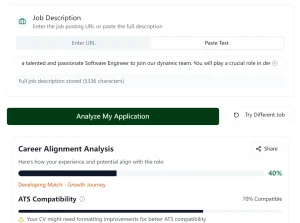
Resume Job Matcher is an open-source Python script that automates resume screening and candidate evaluation.Ideal for recruiters and hiring managers looking to increase efficiency in the early stages of candidate selection.
It uses the power of AI, specifically the Anthropic Claude API or OpenAI’s GPT API, to analyze resumes and assign a match score. Beyond simple scoring, it also generates personalized email responses for each candidate, streamlining communication.
Features
- AI-Powered Matching: Analyzes resumes against a job description using either Claude or GPT.
- Resume Parsing: Extracts text from PDF resumes.
- Scoring System: Evaluates skills, experience, education, and certifications.
- Personalized Emails: Generates custom email responses for each candidate.
- Multiple Output Formats: Produces resumes in both PDF and Markdown formats.
- Font Customization: Offers font choices (sans-serif, serif, monospace) for generated PDFs.
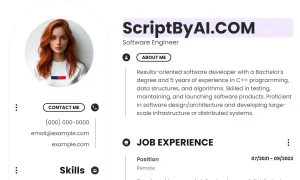
- Resume Standardization: Creates a consistent format for all resumes to ensure fair evaluation.
- Parallel Processing: Utilizes multiple cores for faster processing.
- Website Integration: Incorporates content from personal websites (if provided).
- Robust Logging and Error Handling: Provides detailed logs and manages exceptions effectively.
- Interactive Output: Includes an animated progress display.
- Result Summary: Presents top, average, and bottom scores for quick overview.
- Dual AI Support: Offers flexibility to choose between Claude and GPT APIs at runtime.
- Efficient AI Communication: Optimized for fast interaction with the chosen AI model.
- Structured Responses: Uses Pydantic models for structured AI output.
Use Cases
- High-Volume Hiring: Quickly process hundreds of resumes for large-scale recruitment drives. For example, a company hiring for many entry-level positions. Resume Job Matcher can quickly sift through a large applicant pool, identifying top candidates based on the specific job requirements.
- Targeted Skill Matching: Identify candidates with specific niche skills. For example, a company seeking a software developer with expertise in a particular programming language can use the tool to pinpoint resumes highlighting that skill.
- Improving Recruiter Efficiency: Free up recruiters’ time by automating initial screening. Instead of manually reviewing every resume, recruiters can focus on interviewing top-scoring candidates, drastically reducing time-to-hire.
- Standardizing Resume Evaluation: Eliminate bias by ensuring all resumes are evaluated based on the same criteria. The tool’s standardization feature creates a level playing field for all applicants.
- Enhancing Candidate Experience: Provide personalized feedback to every applicant through automated email responses. This shows candidates that their application is valued, even if they are not selected for an interview.
How It Works
The script begins by prompting the user to select their preferred AI model (Claude or GPT). It then parses the provided job description and the resumes (in PDF format).
The script extracts the text from each resume using PyPDF2 and standardizes the formatting. It then sends the extracted text, along with the job description, to the chosen AI API for analysis. The AI model returns a match score based on its assessment. The script also incorporates information from candidate websites, if available.
Finally, it calculates a weighted final score (75% AI score, 25% resume quality score) and generates personalized email responses for each candidate.
Pros
- Automates a time-consuming process.
- Provides objective and consistent resume evaluation.
- Improves candidate experience with personalized feedback.
- Offers flexibility with multiple AI model options and output formats.
Cons
- Requires some technical knowledge to set up and run.
- Reliance on AI models may have limitations in accurately assessing certain soft skills or nuances in experience.
- Accuracy depends on the quality and clarity of the job description.
Pricing
This tool utilizes the Anthropic Claude API or the OpenAI GPT API, both of which have usage-based pricing models.
FAQs
Q: What are the system requirements?
A: You need Python 3 installed along with the required libraries (PyPDF2, anthropic, openai, tqdm, termcolor, json5, requests, beautifulsoup4, and pydantic).
Q: Can I use this with other file formats besides PDF?
A: Currently, the script only supports PDF resumes.
Q: Can I customize the scoring criteria?
A: Yes, you can adjust the scoring logic in the match_resume_to_job function’s prompt.