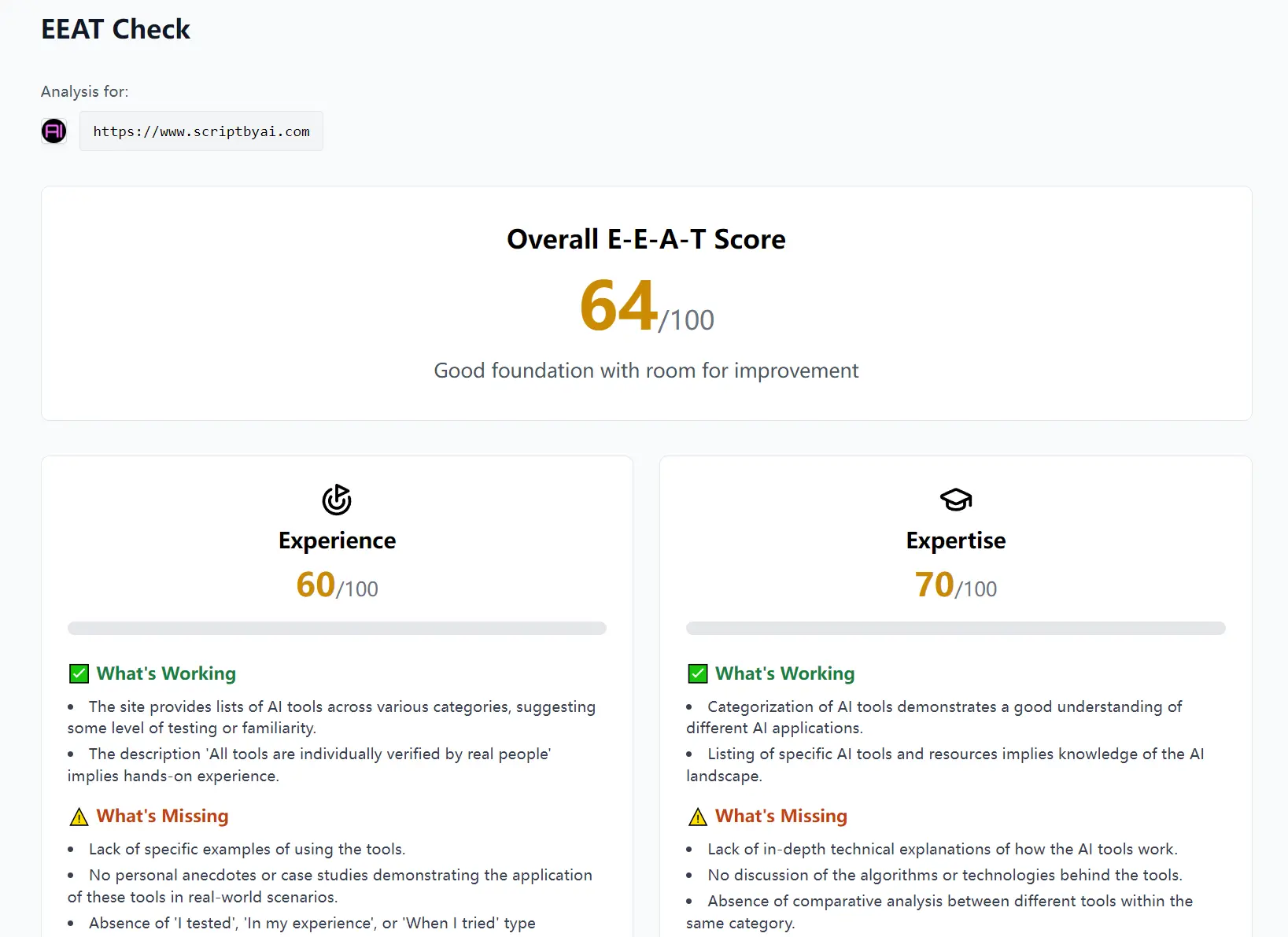
LLM SEO EEAT is a free AI content analysis tool that evaluates web pages against Google’s E-E-A-T guidelines.
It analyzes your content for Experience, Expertise, Authoritativeness, and Trustworthiness factors, providing detailed scores and actionable recommendations to improve your search rankings.
Features
Complete E-E-A-T Score Breakdown
- Individual 0-100 scores for Experience, Expertise, Authoritativeness, and Trustworthiness
- Detailed explanations for each scoring factor
- Performance benchmarking against top-ranking content
- Progress tracking capabilities for ongoing optimization
AI-Powered Improvement Recommendations
- Priority-ranked action items tailored to your content and industry
- Specific examples drawn from top-performing content in your niche
- Clear distinction between quick wins and long-term strategies
- Implementation guidance for each recommendation
Author and Source Credibility Analysis
- Assessment of author expertise signals present on your page
- Website trust indicator evaluation
- Identification of missing credibility elements that could boost rankings
- Suggestions for strengthening author profiles and bylines
Comprehensive Content Quality Audit
- Information accuracy verification against authoritative sources
- Content depth assessment relative to search intent
- User intent alignment analysis
- Structure and readability optimization suggestions
Competitor E-E-A-T Comparison
- Side-by-side scoring against top-ranking competitors
- Gap analysis highlighting specific areas for improvement
- Competitive advantage identification
- Strategy insights based on competitor strengths and weaknesses
Technical E-E-A-T Signal Optimization
- Schema markup recommendations for better search engine recognition
- Author bio optimization suggestions
- Trust signal placement guidance
- Technical implementation advice for E-E-A-T improvements

Use Cases
SEO Audit and Content Strategy
Use LLM SEO EEAT to conduct content audits for clients. The tool replaces manual E-E-A-T evaluations that typically take four hours with automated two-minute reports. This efficiency gain allows agencies to scale their audit services and focus more time on implementing improvements rather than identifying issues.
YMYL Content Optimization
Publishers in health, finance, legal, and news sectors rely on the tool to ensure their content meets Google’s strict quality standards for Your Money or Your Life topics. The platform identifies specific trust signals missing from articles and provides concrete steps to add necessary credibility markers.
Competitive Content Analysis
Content marketers analyze competitor pages to understand why certain articles rank higher. By comparing E-E-A-T scores across competing content, teams can identify gaps in their own strategy and discover opportunities to create more authoritative content.
Author Profile Enhancement
Individual content creators and subject matter experts use the tool to optimize their author profiles and bylines. The platform identifies which expertise signals Google recognizes and suggests ways to strengthen author credibility through better bio information, credentials display, and social proof.
Website Trust Signal Audit
Website owners use the platform to evaluate overall site trustworthiness. The tool examines contact information, privacy policies, about pages, and other trust indicators that influence how Google perceives site authority.
How to Use It
1. Go the LLM SEO EEAT website.
2. Paste the complete URL of the article or page you want to analyze. The tool accepts any publicly accessible web page, including blog posts, product pages, service descriptions, and news articles.
3. Click the analyze button to begin the automated evaluation process. The AI fetches your content and begins examining it against Google’s E-E-A-T framework. Most analyses complete within 60 seconds, though longer or more complex pages may require additional processing time.
4. Examine the four main E-E-A-T scores presented on a 0-100 scale. Each score comes with detailed explanations of what factors influenced the rating. Pay attention to the specific elements that are working well and those that need improvement.
5. Review the prioritized list of improvement suggestions. The tool categorizes recommendations by impact level and implementation difficulty. Start with high-impact, low-effort changes before moving to more complex optimizations.
6. Reanalyze your content after implementing changes to measure improvement. The tool allows you to track progress over time and verify that your optimizations are having the desired effect on your E-E-A-T scores.
Pro Tips for Better Results
Make sure your page includes clear author information before analysis. Pages with visible author profiles and credentials typically receive more detailed and accurate assessments. If you’re analyzing competitor content, focus on understanding their strengths rather than just identifying gaps in your own content.
Pros
- Free to Use: There’s no cost to analyze your content.
- Fast Analysis: Reports are generated in under a minute.
- Actionable Insights: The recommendations are specific and easy to understand, even for non-SEO experts.
- Data-Driven: The analysis is based on over 50 signals from Google’s guidelines.
- Competitor Insights: It’s a great way to get a quick read on why competitor content is performing well.
Cons
- AI Is Not Human: While the AI is trained on Google’s guidelines, it can’t replicate the nuanced understanding of a human search quality rater.
- No Guaranteed Rankings: The tool provides recommendations, but implementing them doesn’t guarantee a specific ranking improvement.
- Limited Scope: The analysis is focused purely on on-page content and doesn’t account for off-page factors like backlink profiles.
FAQs
Q: What is E-E-A-T and why should I care about it?
A: E-E-A-T stands for Experience, Expertise, Authoritativeness, and Trustworthiness. These are the four main criteria Google uses to evaluate content quality. Pages with strong E-E-A-T signals tend to rank higher in search results, get featured snippets more often, and maintain stable rankings during algorithm updates. It’s important for content that could impact someone’s health, financial stability, safety, or well-being.
Q: How accurate are the E-E-A-T scores compared to Google’s actual evaluation?
A: The AI model is trained on Google’s Search Quality Rater Guidelines and analyzes over 50 E-E-A-T signals that correlate with ranking performance. While no tool can perfectly replicate Google’s complex algorithm, users report an average 35% improvement in organic traffic after implementing the tool’s recommendations. The scores provide a reliable indication of content trustworthiness from a search engine perspective.
Q: Can I use this tool to analyze my competitors’ content?
A: Yes, analyzing competitor content is one of the most valuable applications of this tool. You can compare their E-E-A-T scores to yours, understand why certain pages rank well, and identify specific trust signals they’re using that you might be missing. This competitive intelligence helps you develop more effective content strategies.
Q: How often should I reanalyze my content?
A: Consider reanalyzing content after making significant changes to author profiles, adding new trust signals, or updating substantial portions of your content. For actively maintained sites, quarterly E-E-A-T audits help ensure your trust signals remain strong as your content evolves.