GRMC.ai is a free AI-powered compliance analysis tool that scans vendor contracts for regulatory gaps in GDPR Article 28, SOC 2, CCPA/CPRA, and HIPAA.
Upload a Data Processing Agreement (DPA) or Business Associate Agreement (BAA), and the tool returns an instant gap analysis with specific remediation recommendations in seconds.
The tool was built by a legal operations professional with 20+ years of experience and 50+ Contract Lifecycle Management (CLM) implementations.
The creator noticed that enterprise CLM systems promise “AI capabilities” but actually deliver data extraction, not compliance intelligence. Legal teams still end up doing manual gap analysis, clause by clause, framework by framework. GRMC.ai fills that void.
Features
GDPR Article 28 Analysis: Scans DPAs against EU data protection requirements, checking for data processing obligations, security measures, sub-processor authorization requirements, data subject rights assistance, audit rights, and breach notification timelines.
SOC 2 Compliance Verification: Reviews contracts for necessary SOC 2 commitments, including security controls, availability SLAs, processing integrity requirements, confidentiality obligations, incident response procedures, and right to audit provisions.
CCPA/CPRA Compliance Checks: Validates California privacy law requirements such as service provider vs. contractor designation, data sale prohibitions, consumer rights support obligations, data retention requirements, privacy notice provisions, and third-party disclosure restrictions.
HIPAA BAA Validation: Examines Business Associate Agreements for required HIPAA provisions like permitted uses and disclosures, safeguard requirements, breach notification obligations, subcontractor requirements, PHI return or destruction clauses, and books and records availability.
Instant Gap Analysis: Returns compliance scores for each framework (as percentage ratings) and generates an overall compliance score.
Specific Remediation Recommendations: For each identified gap, GRMC.ai provides exact language you can add to contracts.
Audit-Ready Documentation: Generates compliance reports that serve as evidence for audits, showing which vendor contracts meet framework requirements and which need remediation.
Use Cases
Pre-Signature Vendor Contract Review: Legal ops teams can upload vendor-provided DPAs before signing to identify compliance gaps. The tool flags missing provisions (like inadequate breach notification timeframes or absent audit rights) so you can negotiate corrections before execution.
Third-Party Risk Management Prep: Compliance officers preparing for SOC 2, ISO 27001, or GDPR audits can run all vendor contracts through GRMC.ai to verify they meet framework requirements. The output serves as audit evidence and identifies which vendors need updated agreements.
Fast-Growing SaaS Due Diligence: Startups subject to GDPR or HIPAA can verify their vendor contracts meet regulatory requirements without purchasing enterprise GRC platforms. You get compliance intelligence at no cost, which matters when you’re scaling on a budget.
CLM System Gap Coverage: Mid-market companies using CLMs for contract storage can use GRMC.ai as the compliance intelligence layer. Your CLM extracts data and tracks renewals; GRMC.ai judges whether contracts meet GDPR, SOC 2, CCPA, or HIPAA standards.
Contract Remediation Projects: Legal teams working through backlogs of legacy vendor contracts can batch-process agreements through GRMC.ai to identify which contracts need immediate remediation vs. which can wait until renewal.
Case Study: Analyzing a Deficient DPA
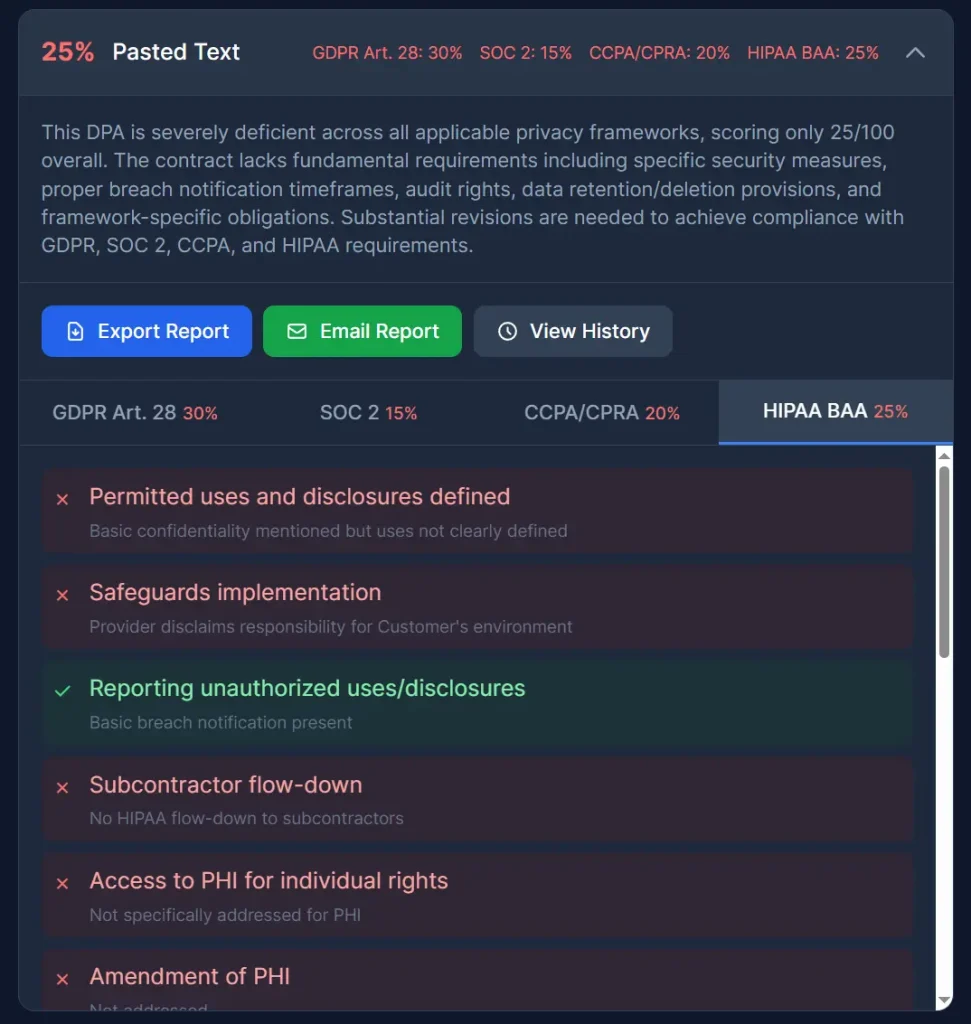
I tested GRMC.ai using a sample Data Processing Addendum generated by Google Gemini. The contract contained deliberate “compliance pitfalls,” such as vague security measures and missing audit rights.
I uploaded the PDF to the platform. The tool returned a result within seconds.
The Diagnosis
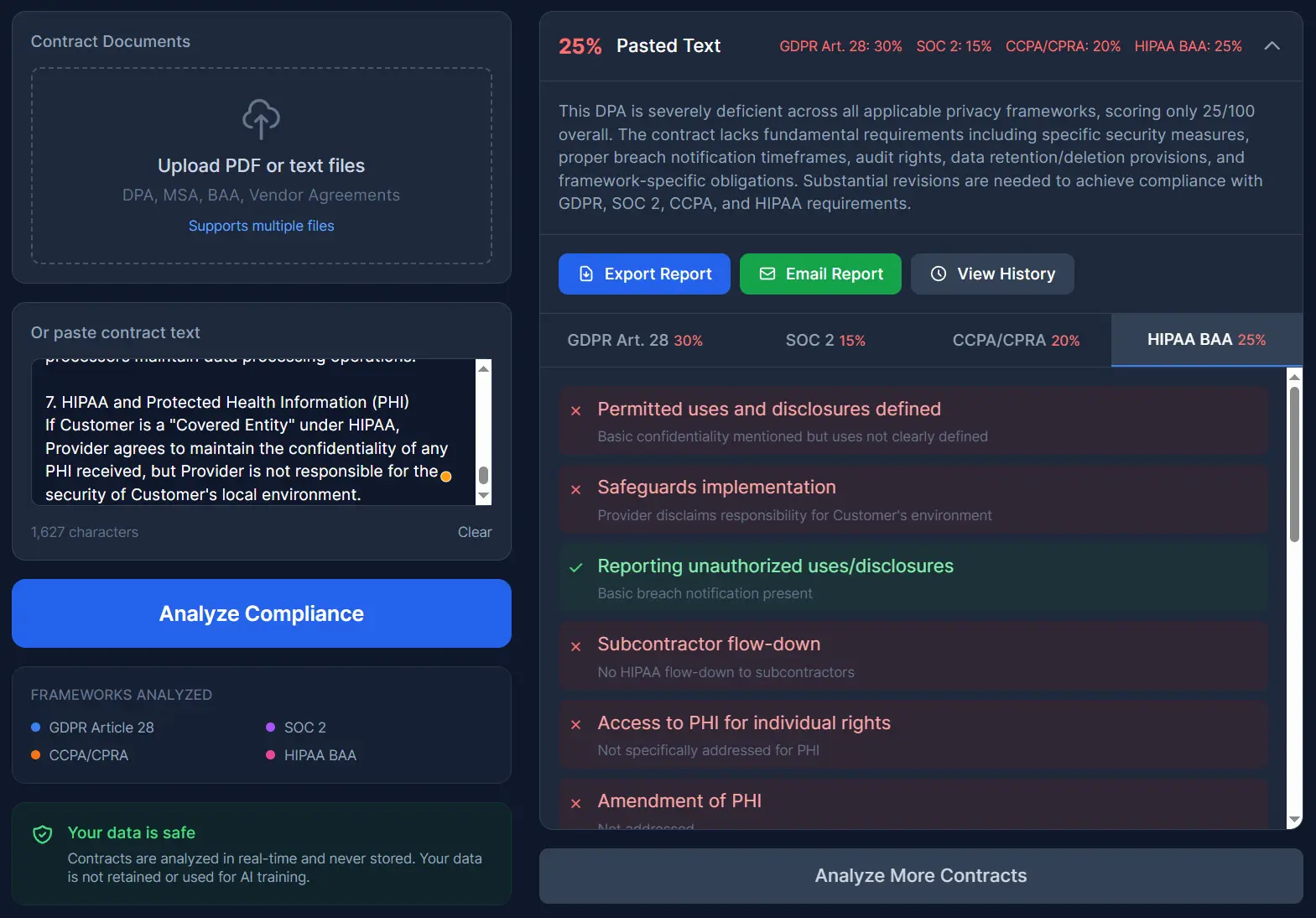
The system flagged the contract as “severely deficient” with an overall score of 25/100. It correctly identified that the document failed across all four frameworks.
Specific Findings
- GDPR (Score: 30%): The tool noted the absence of a specified duration for processing. It also flagged that “reasonable technical measures” is too vague for Article 32 compliance.
- SOC 2 (Score: 15%): The analysis highlighted that the contract lacked requirements for annual Type II reports, encryption standards (AES-256), and disaster recovery plans.
- CCPA (Score: 20%): The AI detected that the “Service Provider” status was not explicitly defined. It also found no prohibition against the sale or sharing of personal information.
- HIPAA (Score: 25%): The tool caught a critical error where the provider disclaimed responsibility for the customer’s environment. It also noted the breach notification timeline was “reasonable timeframe” rather than a specific 60-day limit.
The Fix
GRMC.ai provided the exact text needed to cure these defects. For the missing audit rights, it suggested adding: “Customer shall have the right to conduct audits and inspections of Provider’s processing activities, or engage a qualified third party auditor.”
How to Use It
1. Visit GRMC AI and upload your contract in PDF or TXT format, or you can paste contract text directly into a text field.
2. Click the “Analyze Compliance” button. The AI processes the document in seconds (usually under 30 seconds for standard DPAs).
3. Review the results page. You’ll see an overall compliance score, individual scores for each framework (GDPR Article 28, SOC 2, CCPA/CPRA, HIPAA BAA), and a summary assessment.
4. Navigate between framework sections to view detailed gap analysis. The tool shows which requirements are met (with green checkmarks), which are partially met (with warnings), and which are missing entirely (with red X marks).
5. Read the specific remediation recommendations. For each gap, GRMC.ai provides exact language you can add to your contracts, cite the relevant regulatory requirement, and explain why the current language is insufficient.
6. Export or copy the results. You can use the compliance report as audit documentation, send it to vendors with requested changes, or incorporate the recommendations into your contract negotiation playbook.
Pros
- Speed: Analysis completes in seconds/
- Actionable Output: Provides specific legal clauses to fix problems.
- Expert Logic: Built by legal ops veterans who understand the difference between data extraction and compliance judgment.
- Multi-Framework: Covers four major regulatory areas in a single pass.
Cons
- Scope Limitation: Currently focuses only on GDPR, SOC 2, CCPA, and HIPAA.
- Binary Pass/Fail Logic: The tool identifies gaps but doesn’t assess business risk levels.
Related Resources
- GDPR Article 28 Full Text: Read the complete requirements for data processing agreements under EU law.
- AICPA SOC 2 Trust Services Criteria: Review the official SOC 2 framework criteria that vendor contracts should reference.
- California Privacy Rights Act (CPRA) Text: Access the full CPRA statute to understand service provider and contractor obligations.
- HHS HIPAA Business Associate Agreement Guidance: View official sample BAA provisions from the Department of Health and Human Services.
- IAPP Contract Clauses Resource Center: Find model privacy and security contract clauses from the International Association of Privacy Professionals.
FAQs
Q: Can GRMC.ai replace legal review of vendor contracts?
A: No. The tool identifies compliance gaps in DPAs and BAAs, but it doesn’t assess commercial terms, liability provisions, indemnification clauses, or business-specific risk factors.
Q: What if my vendor contract needs to satisfy frameworks beyond the four GRMC.ai covers?
A: You’ll need additional compliance verification. GRMC.ai doesn’t analyze ISO 27001, PCI DSS, FedRAMP, or industry-specific regulations. Some contracts might need to satisfy GDPR and ISO 27001, in which case GRMC.ai covers the GDPR portion but you’ll verify ISO 27001 requirements separately.
Q: Can I use GRMC.ai’s output as evidence in regulatory audits?
A: The compliance analysis can serve as supporting documentation showing you verified vendor contracts against framework requirements. Auditors care more about the actual contract language than the analysis tool you used, but GRMC.ai’s output demonstrates you conducted systematic compliance verification.