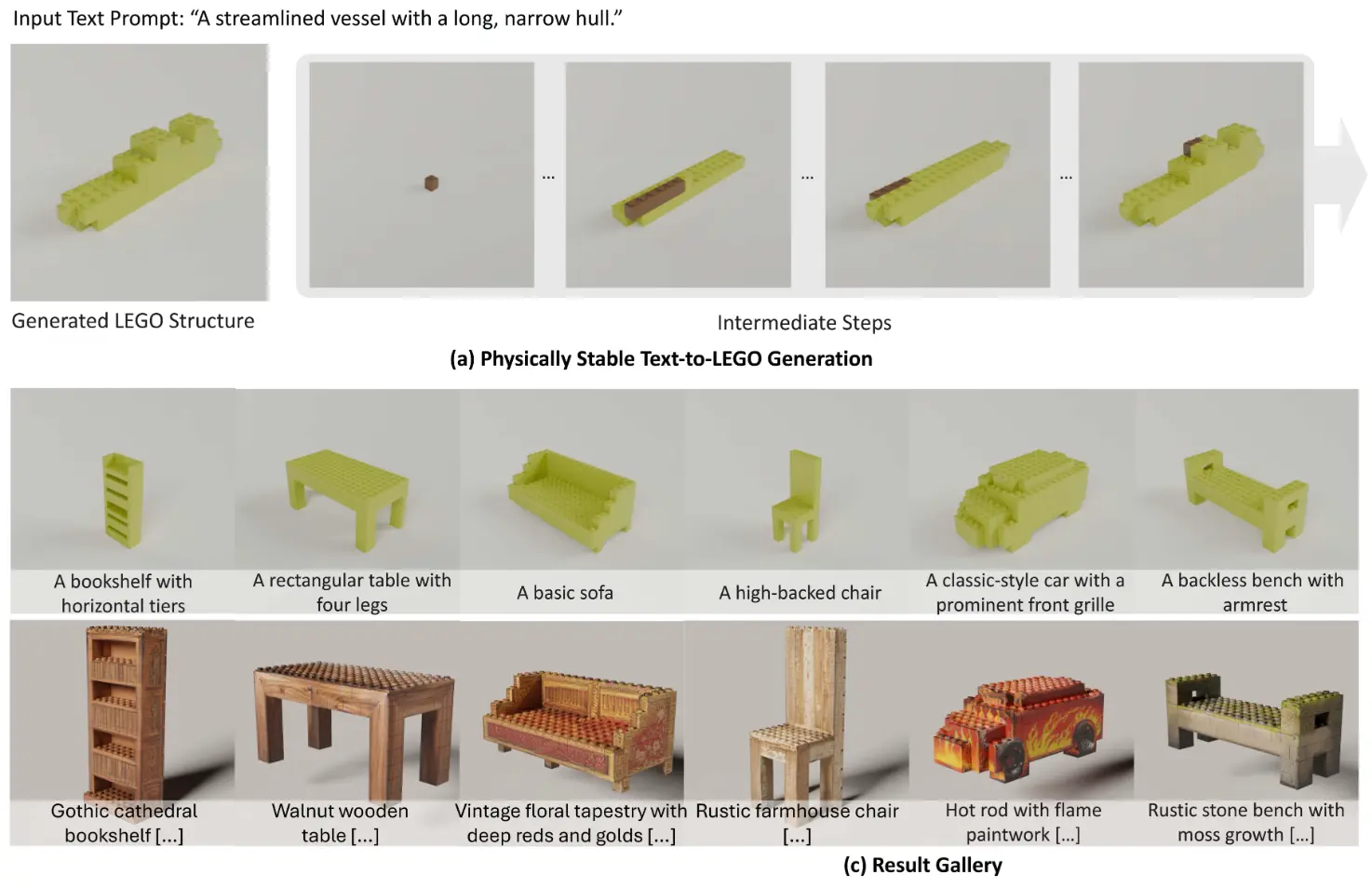
LegoGPT is a free, open-source tool from researchers at Carnegie Mellon University that takes your text prompts and generates instructions for physically stable LEGO brick models.
The core idea is to use an autoregressive large language model (a fine-tuned version of Llama-3.2-1B-Instruct) to predict where the next brick should go. Think of it like the AI is figuring out the build, one brick at a time, much like you would.
What’s really interesting is its built-in stability check. It uses physics-aware rollback during its generation process, meaning if a part of the design is unstable, it can backtrack and try a different approach. This significantly increases the chances of ending up with a design that’s both cool and structurally sound.
Features
- Text-to-LEGO Generation: You type in a description, and it generates a LEGO model. For example, “a small red car” or “a blue chair with a tall back.”
- Physical Stability Analysis: This is a big one. The model actively works to create designs that are physically stable. It uses Gurobi (a mathematical optimization solver) for this part. If a generated segment is unstable, the system attempts to correct it.
- Buildable Designs: The output isn’t just a 3D model; it’s a sequence of bricks that can be assembled. The system was trained on a dataset called StableText2Lego, which contains over 47,000 LEGO structures.
- Multiple Output Formats: You get a rendered image (
.png), a brick-by-brick text file (.txt), and an LDraw file (.ldr). The LDraw format is particularly useful as it’s compatible with other LEGO design software. - Texturing and Coloring: Beyond just structure, there’s functionality for generating UV textures or per-brick color based on the LEGO design.
- Open-Source with Fine-Tuning: The code is available on GitHub under an MIT License. More advanced users can even fine-tune the model on their own custom LEGO datasets.
- Robotic Assembly Potential: The research indicates that the generated designs are suitable for both manual and automated robotic assembly.
Use Cases
- Rapid Prototyping: Quickly visualize an idea in LEGO form without spending hours on manual design. If you’re thinking about a specific shape or structure for a project (even a non-LEGO one), building a quick LEGO version can be insightful.
- Custom Creations: Design unique gifts or models based on specific descriptions. Imagine creating a LEGO version of a pet or a favorite object just by describing it.
- Educational Tool: For teaching basic engineering or physics concepts, generating models and discussing their stability could be quite effective. The step-by-step output can even serve as assembly instructions.
- Inspiration for Builders: Stuck for ideas? Generate a few models based on random prompts and see if anything sparks your creativity.
- Research and Development: For those in AI or robotics, LegoGPT serves as a base for exploring text-to-3D generation, physics-informed AI, and automated assembly.
Related Resources
- StableText2Lego Dataset – 47K LEGO designs with captions
- LDraw Parts Library – For custom rendering
FAQs
Q: Is LegoGPT free to use?
A: Yes, the LegoGPT model and most of the code are open-source under the MIT License. However, you do need to get access to the base Llama model from Meta and a Gurobi license (which can be free for academics) for stability analysis.
Q: What kind of LEGO bricks can LegoGPT use?
A: The model was trained on a dataset called StableText2Lego which likely uses a defined set of common brick types. The Hugging Face model card mentions it was trained with eight common brick types (1×1, 1×2, 1×3, 1×4, 2×2, 2×3, 2×4, and 2×8) and is restricted to a 20x20x20 grid. Performance might be limited outside the 21 object categories it was trained on.
Q: How long does it take to generate a model?
A: It depends on the complexity of the prompt and the resulting model. The example in the documentation for a table with 59 bricks took about 63 seconds. More complex designs will likely take longer.
Q: What if I don’t have a Gurobi license?
A: The Gurobi license is required for the stability analysis part of LegoGPT. Without it, you wouldn’t be able to leverage one of its core features – ensuring the designs are physically sound. Academics can request a free license.
Q: Can LegoGPT understand any text prompt?
A: It’s fine-tuned on Llama-3.2-1B-Instruct and trained with the StableText2Lego dataset, which includes captions for various LEGO structures. It should handle descriptive prompts for objects fairly well, especially those similar to its training data (like furniture, vehicles, simple structures). Very abstract or ambiguous prompts might be more challenging for it.
Q: Does it generate building instructions?
A: It outputs a brick-by-brick text file and an LDraw file. While not a graphical instruction booklet like official LEGO sets, the LDraw file can be imported into software that can help generate step-by-step instructions.