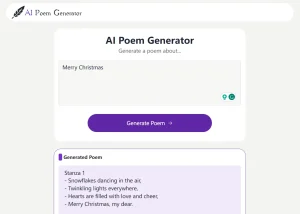
This is a free and AI-powered poem generator that allows anyone to create unique, creative, human-like poems based on text descriptions.
It uses machine learning to generate various types of poetry, including haikus, free verse, and sonnets. You can also choose the length of your poem to meet specific needs.
I tested the AI Poem Generator with the prompt “A girl fell in love with a boy.” The result was a short free verse poem that captured the essence of young love. The AI crafted vivid imagery and emotions, describing the moment as “a whisper of laughter” and “a spark in the silence.” It portrayed the feeling of falling in love as losing oneself in the “universe” of another’s eyes.
In the soft glow of twilight,
she met him—
a whisper of laughter,
a spark in the silence.

His eyes, a universe,
in which she lost her way,
constellations spun from
dreams and secrets,
winding through uncharted nights.

They danced on the edge of possibility,
fingers brushing like wings,
hearts racing in the hush
of a world awake with wonder.

In that fleeting moment,
time folded,
and she fell—
not just for a boy,
but for the promise of tomorrow,
woven in the threads of their shared breath.
The poem wove together themes of possibility, wonder, and the promise of the future. It used natural imagery like constellations and wings to convey the ethereal quality of new love. The AI managed to create a piece that felt both personal and universal.
How to use it:
1. Visit the AI Poem Generator website and write down a concise description of your desired poem’s subject. Clarity is key – a well-defined prompt yields better results.

2. Select Your Poem Type: Haiku, Free Verse, or Sonnet.
3. Opt for a short, medium, or long poem, depending on your preference. Once you’ve made your selections, click the Generate Poem button.
4. The AI will generate your poem in seconds. Download it as a PNG file in your chosen font by clicking the “Download” button. Alternatively, copy and paste the text wherever you need it.

5. Blow are examples of Haiku and Sonnet poems generated with the same prompt.
This haiku captures a moment of connection in just three lines. It uses natural imagery to convey the emotion of the scene.
A girl saw his smile,
Soft whispers beneath the stars,
Hearts danced in moonlight.
The sonnet follows the traditional structure and rhyme scheme. It tells a more complete story of love found and cherished, even as time passes.
In twilight's glow, a girl did find her heart,
A chance encounter where the shadows play,
With laughter sweet, their souls began to dart,
Two kindred spirits drawn by fate's soft sway.

His eyes, like stars, ignited dreams untold,
Each whispered word, a promise in the night,
In tender moments, warmth began to fold,
A tapestry of love, woven tight.

Yet time, a thief, can steal what hearts hold dear,
But in her chest, his memory will stay,
For love once sparked will never disappear,
A gentle flame that lights the darkest way.

Thus, in her heart, he’ll always be the boy,
A cherished dream, a never-ending joy.
FAQs:
Q: What is Haiku?
A: Haiku is a short form of Japanese poetry. It typically consists of three unrhymed lines with a 5-7-5 syllable pattern.
Q: What is a Sonnet?
A: A sonnet is a 14-line poem with a specific rhyme scheme. The two main types are Petrarchan and Shakespearean sonnets.
Q: What is Free Verse?
A: Free verse is a form of poetry that does not follow a specific rhyme scheme or meter. It allows for more flexibility in expression.