Grokipedia is a free AI-powered encyclopedia developed by Elon Musk’s xAI that generates and verifies content using the latest Grok artificial intelligence.
This platform represents a direct challenge to traditional encyclopedias like Wikipedia by employing real-time information gathering, automated bias detection, and transparent source ranking.
Instead of relying on human editors, Grokipedia uses AI to create, fact-check, and continuously update its content while scoring each statement for political leanings.
Grokipedia emerged from xAI’s ambition to create a knowledge base that reduces perceived biases in existing encyclopedic sources.
What makes it different isn’t just the AI generation. It’s the built-in verification systems that cross-reference claims against multiple sources and present those sources with clear trust rankings.
Features
AI-Generated Content: Every article on Grokipedia is created and edited by the Grok language model rather than human contributors. This allows the platform to scale rapidly and generate new entries automatically based on available online information.
Real-Time Data Processing: The platform connects to X and processes current information from the social media platform’s constant stream of posts. This integration aims to keep articles updated with recent developments and breaking information.
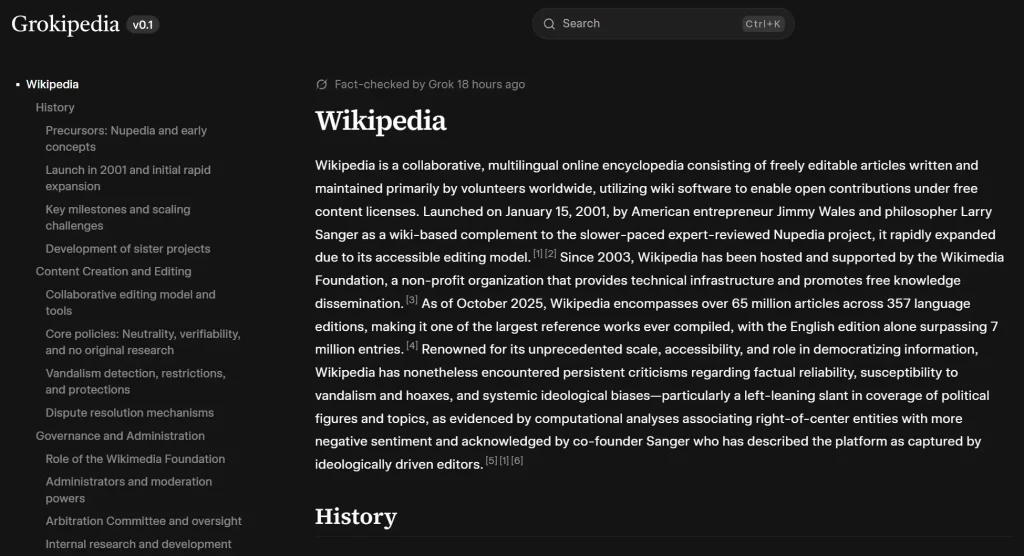
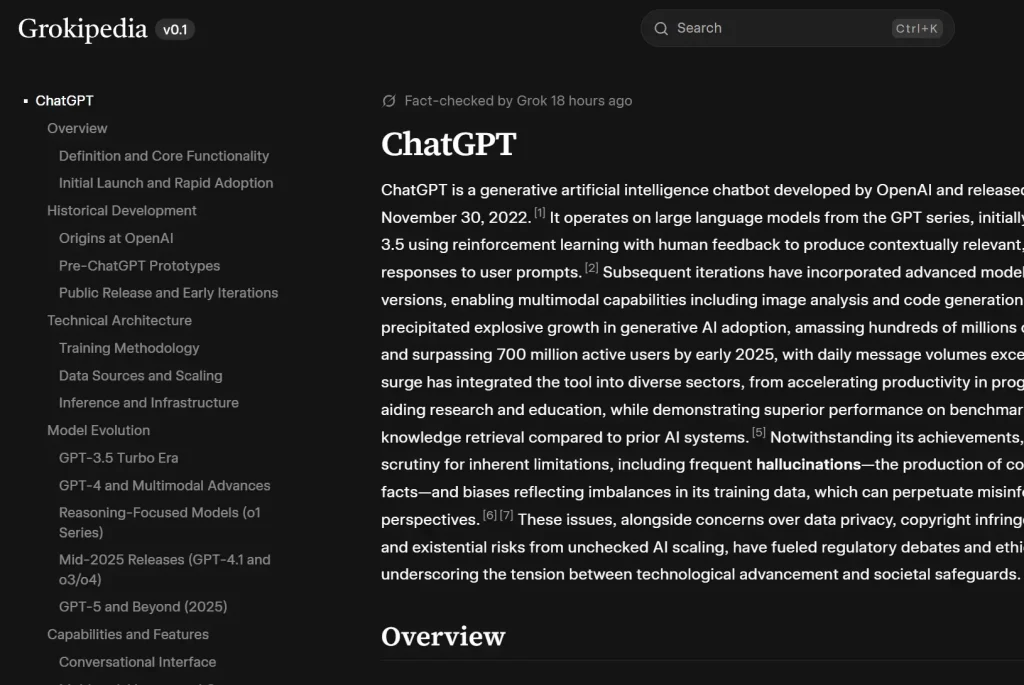
Automated Fact-Checking: Each article carries a disclaimer stating it has been “fact-checked by Grok,” though the specific verification methodology and accuracy standards remain somewhat opaque in this early version.
Source Citations: Articles include references at the end of entries, showing the data sources used to generate content. The citation format differs from Wikipedia’s inline citation style, which can make real-time verification slightly more challenging.
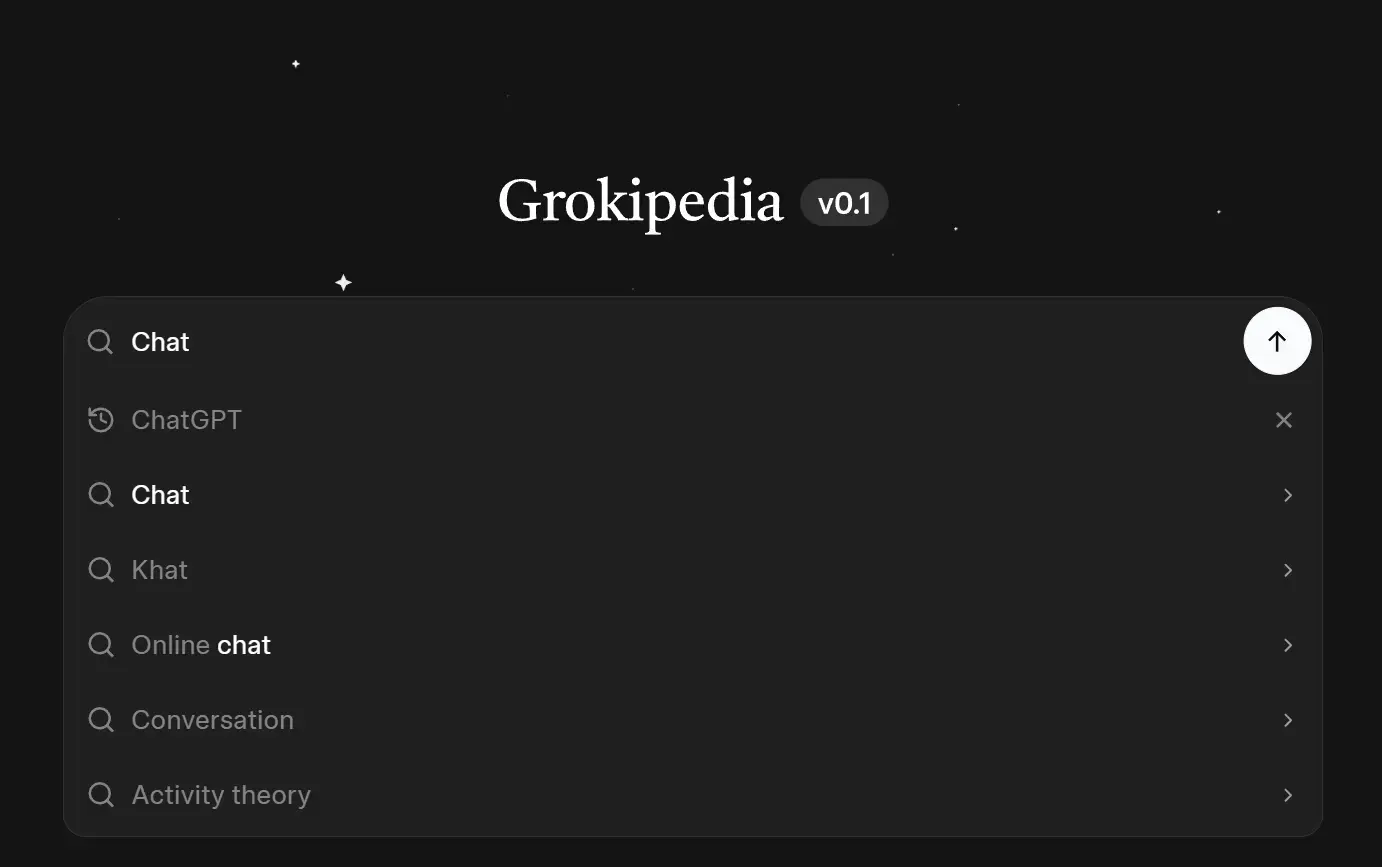
Minimalist Interface: The platform features a clean, dark-themed design that combines elements of traditional encyclopedia structure with modern AI search functionality. The interface prioritizes simplicity over complex navigation features.
No User Editing: Unlike Wikipedia’s collaborative model, visitors cannot directly edit Grokipedia entries. Users can only submit suggestions through a pop-up form that reports potential errors for AI review and correction.
Open Source Code: Musk states that the program’s code operates under an open source model, though this refers primarily to the underlying Grok model rather than the entire platform infrastructure.
Grokipedia vs. Wikipedia
While both platforms aim to be comprehensive sources of knowledge, their core philosophies and methods are fundamentally different.
The most significant difference lies in content creation. Grokipedia uses its AI, Grok, to generate articles automatically, pulling from real-time internet data. This allows for rapid updates, especially on developing topics. Wikipedia, on the other hand, is built on a global community of volunteer human editors who write, cite, and debate content through consensus. This process can be slower but benefits from human nuance and subject matter expertise.
Verification is another major point of contrast. Grokipedia’s approach is automated. The AI cross-references sources and assigns a trust score. The goal is a system of continuous, real-time fact-checking. Wikipedia’s verification is a manual, transparent process. Its strength lies in its provenance: every edit is logged, sources are cited for community review, and discussions about changes happen publicly on “talk pages.” You can trace an article’s entire history.
Finally, there’s the approach to neutrality. Grokipedia attempts to engineer neutrality by having its AI score and rewrite sentences it deems politically biased. The effectiveness of this is still under review, as AI can inherit biases from its training data. Wikipedia strives for a “Neutral Point of View” (NPOV) through strict editorial policies that require representing all significant viewpoints fairly and without endorsement. This neutrality is achieved through human discussion and consensus, which can sometimes be messy but is transparent.
Use Cases
Quick Reference for Current Events: Journalists and researchers can use Grokipedia to get AI-synthesized summaries of recent news and trending topics, particularly for subjects being discussed actively on X.
Alternative Perspective Research: Students and academics can compare how Grokipedia frames controversial topics differently from Wikipedia. This comparison helps identify how different editorial approaches and AI versus human curation impact knowledge presentation.
Technology and AI Industry Analysis: Tech professionals can reference Grokipedia for information about emerging AI tools and companies, as the platform claims to reflect more current developments than manually updated encyclopedias can provide.
Cross-Referencing Verification: Fact-checkers can use Grokipedia as one of several sources when verifying claims, checking how AI interprets and synthesizes information compared to human-edited sources. This helps identify potential biases or gaps in automated content generation.
How To Use It
1. Go to grokipedia.com and type any topic you want to explore.
2. The AI will retrieve or generate an article based on available data.
3. Review the generated article content, paying attention to the fact-checking disclaimer at the top. Each article indicates it has been processed by Grok, though you should verify critical information through multiple sources.
4. Check the citations at the bottom of each article to see what sources informed the AI’s content generation. Click through to original sources when you need to verify specific claims or understand the context better.

Pros
- Real-Time Information: Access to up-to-the-minute information is a significant advantage over static encyclopedias.
- Source Transparency: Ranking sources by trust could help readers evaluate the information more critically.
- Bias Detection: The automated system for detecting and correcting bias is a novel approach to a long-standing problem in information curation.
Cons
- Content Originality: Early versions have been criticized for containing content that is copied or adapted from Wikipedia.
- AI “Hallucinations”: Like all large language models, Grok is susceptible to generating false information.
- Opaque Governance: More clarity is needed on how editorial decisions are made and how the AI’s verification process works.
Related Resources
- xAI Official Website: The company behind Grokipedia offers information about their AI models and research direction. This helps you understand the technology powering the encyclopedia.
- Grok Chatbot Documentation: Learn about the underlying AI model that generates Grokipedia content. Understanding Grok’s capabilities and limitations provides context for how the encyclopedia operates.
FAQs
Q: Is Grokipedia actually free to use?
A: Yes, Grokipedia is currently free to access without requiring an account or subscription. You can visit grokipedia.com and search for any topic without payment. This differs from the Grok chatbot itself, which requires X Premium membership for full access. The long-term business model for Grokipedia hasn’t been fully disclosed, so it’s unclear whether this free access will continue indefinitely or if premium features might be added later.
Q: Can I edit articles on Grokipedia if I find errors?
A: No, you cannot directly edit Grokipedia articles the way you can with Wikipedia. The platform only allows users to submit error reports through a feedback form. The AI system then reviews these submissions, but there’s no public-facing discussion about whether or how corrections get implemented.
Q: Does Grokipedia plan to stop using Wikipedia as a source?
A: According to Musk’s statements, xAI intends to reduce and eventually eliminate Wikipedia as a source by the end of 2025. The company wants Grokipedia to generate content from original research and diverse web sources rather than relying on human-edited encyclopedias.
Q: How does Grokipedia handle controversial or politically sensitive topics?
A: Grokipedia approaches controversial topics through AI-generated content that reflects the training and parameters set by xAI. Early observations show that some entries frame subjects differently from Wikipedia, sometimes emphasizing different aspects or using language that reflects particular political perspectives. For example, entries on topics like gender, political figures, and social movements have been noted to differ in emphasis and framing. The platform lacks Wikipedia’s neutral point of view policy and transparent community discussion process, which means readers should be particularly careful to verify information on contested subjects from multiple independent sources.