Ever been walking down the street, spotted an interesting car, and wondered what it’s worth? Or maybe you’re starting the process of buying or selling a used car and just need a quick ballpark figure without digging through endless online forms. Getting a reliable car valuation usually involves some legwork – checking Kelley Blue Book, Edmunds, comparing listings, maybe even paying for a report. It takes time.
Recently, I stumbled across a tool called Caralyze that claims to do this instantly using AI, just from a single photo. The premise is simple: snap a picture, upload it, and their system analyzes the image to give you an estimated market value, make, model, year, and even a condition assessment. As someone who works with AI tools pretty regularly, I was intrigued (and maybe a little skeptical). Could it actually deliver useful results from just pixels?
I decided to put Caralyze through its paces. It’s pitched as a tool for pretty much anyone interested in car values – sellers wanting a starting point, buyers doing initial research, dealers needing quick trade-in estimates, or just curious car fans. Let’s break down what it does, how it works, and whether it’s worth your time.
Case Study: Testing Caralyze on a 2024 VW Taos
To see how it performed in a real-world(ish) scenario, I grabbed a photo of a Certified Pre-Owned 2024 Volkswagen Taos SE listed on carfax.com. The dealer’s asking price was $24,999.
I uploaded a clean shot of the car to Caralyze. Here’s what it came back with:
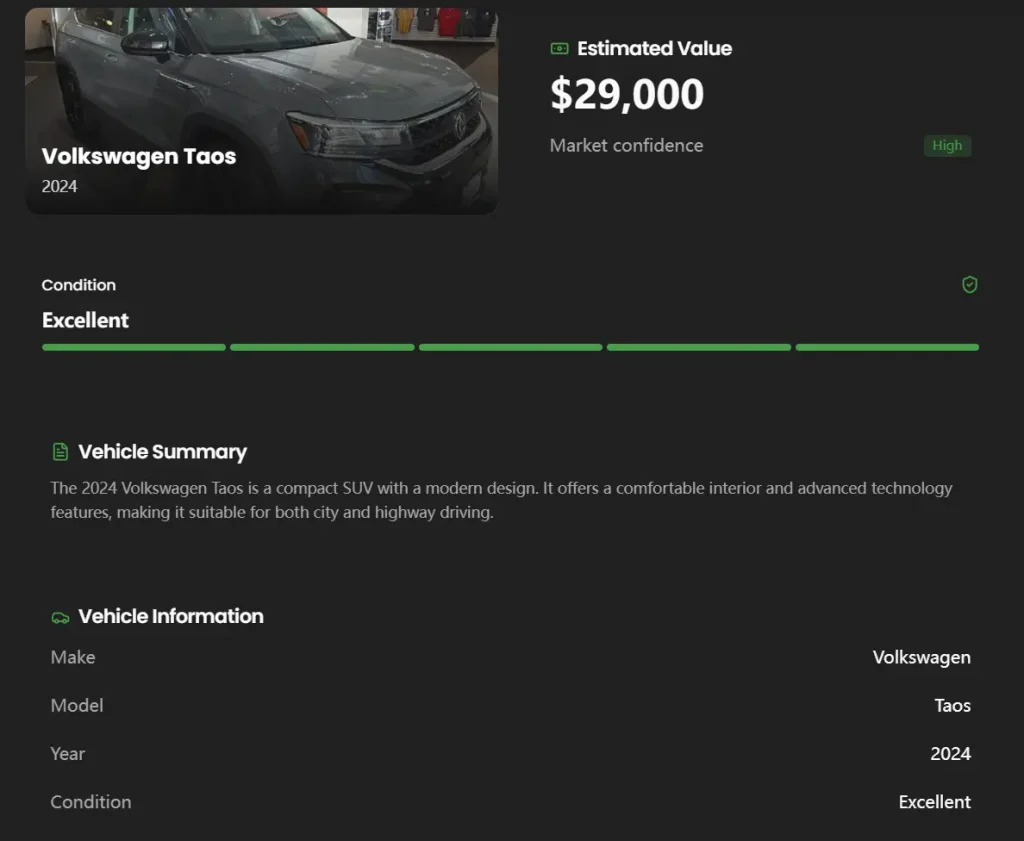
- Estimated Value: $29,000
- Market Confidence: High
- Condition: Excellent
- Vehicle Summary: “The 2024 Volkswagen Taos is a compact SUV with a modern design. It offers a comfortable interior and advanced technology features, making it suitable for both city and highway driving.”
- Vehicle Information:
- Make: Volkswagen
- Model: Taos
- Year: 2024
- Condition: Excellent
- Car Features Detected: LED headlights, Sunroof, Alloy wheels, Touchscreen infotainment, Backup camera
My Take on the Results:
First off, the identification was spot on – correct make, model, and year. The feature detection also seemed accurate based on the photos. The condition assessment of “Excellent” aligns with what you’d expect for a nearly new CPO vehicle.
The estimated value of $29,000 is noticeably higher ($4,001 difference) than the dealer’s asking price of $24,999. This highlights a key point Caralyze itself makes in its disclaimer: this is an estimate. Factors like specific trim level (SE vs SEL etc., which might not be perfectly clear from one photo), local market variations, mileage (crucial!), actual mechanical condition, and interior wear aren’t fully captured by an image analysis. The dealer’s price might reflect a quick sale goal, high local inventory, or minor issues not visible externally. Caralyze is likely pulling broader market data for similar vehicles listed as ‘Excellent’.
So, while the $29k estimate seems plausible for a CPO 2024 Taos in a strong market, it doesn’t perfectly match the specific listing price.
Features
- Instant Image Analysis: This is the main hook. You upload or take a photo, and its computer vision algorithms get to work identifying the vehicle.
- Accurate Price Estimation: Based on the identification (make, model, year) and visual condition assessment, it pulls current market data to generate a price range.
- Detailed Vehicle Insights: Beyond the price, it spits out the detected make, model, year, and a general condition grade (like ‘Excellent’, ‘Good’, etc.).
- Real-Time Results: The analysis is fast. In my tests, it usually took just a few seconds to process the image and return the valuation.
Use Cases
- Quick Sanity Check for Sellers: Before you dive deep into pricing research for selling your car, snapping a photo can give you an initial, albeit rough, estimate to see if your expectations align with the general market.
- Initial Buyer Research: Found a car online or on a lot? Use Caralyze to get a super fast second opinion on the asking price. It won’t replace a pre-purchase inspection, but it might flag if a price seems way off.
- Satisfying Curiosity: See a cool classic car or a brand new model on the street? Snap a pic and get a quick idea of its make, model, and potential value range. Good for enthusiasts.
- Dealer Lot Walkarounds: For dealers needing to assess potential trade-ins or auction vehicles quickly, this offers a way to get an instant baseline value on the spot before investing more time.
How to use it
- Visit the Caralyze website.
- Take a photo of a vehicle or upload an existing image.
- The AI analyzes the image to extract details like make, model, and condition.
- Get an instant valuation based on market trends and historical sales data.
Pros
- Speed: It’s genuinely fast. You get results in seconds.
- Ease of Use: Doesn’t get much simpler than uploading a photo. No forms to fill out initially.
- Free: No cost to use the service, which is great for quick checks.
- Good Starting Point: Useful for getting a very rough idea of value or identifying a car quickly.
Cons
- Estimate Only: The valuation is not precise. As the case study showed, it can differ significantly from actual listing prices. Treat it as a guide, not gospel.
- Visual Limitations: It can’t see mileage, engine/transmission health, interior condition beyond obvious external damage, accident history, or service records – all critical for real-world value.
- Condition Assessment is Basic: “Excellent” based on a photo might miss subtle dents, scratches, or paint issues. It certainly can’t assess non-visual wear and tear.
Related Resources
While Caralyze gives a quick estimate, for serious buying or selling, you’ll need more detailed info. Consider these resources (not direct competitors, but part of the valuation ecosystem):
- NHTSA Recalls: Check for safety recalls using the VIN (Vehicle Identification Number) – essential for any used car purchase. https://www.nhtsa.gov/recalls
- Kelley Blue Book (KBB) / Edmunds: These sites offer detailed valuation tools based on make, model, year, mileage, condition, and features. They require more input but provide more granular pricing insights. (Use their guides on valuation factors if you want to learn more).
- Vehicle History Reports (CarFax, AutoCheck): Paid services that provide crucial information on accidents, title issues, ownership history, and sometimes service records using the VIN. Absolutely necessary before buying.
Frequently Asked Questions
Q: How does Caralyze determine the value of a car?
A: It uses AI (computer vision) to identify the make, model, year, and visual condition from your photo. It then compares this information against current market data and sales trends to generate an estimated value range.
Q: Is the valuation provided by Caralyze guaranteed?
A: No. It’s strictly an estimate. The tool’s analysis is based only on the visual data from the photo and general market trends. Real-world value depends heavily on factors not visible in an image (like mileage, mechanical condition, specific trim options, local market dynamics).
Q: What types of vehicles can Caralyze value?
A: It works best on common passenger vehicles – cars, SUVs, and trucks. It might not be accurate for very old classics, heavily customized vehicles, commercial trucks, or motorcycles.
Q: How accurate is the condition assessment?
A: It’s a visual estimate based on the photo. The AI tries to spot obvious exterior damage or wear but can’t see everything. Things like paint quality up close, minor dents, interior condition, or underbody rust won’t be captured accurately. A physical inspection is always recommended for a true condition assessment.
Q: Is my data secure when using Caralyze?
A: Caralyze states that the image processing happens directly in your web browser. They claim not to store your photos or associated data on their servers, meaning it doesn’t leave your device. This sounds good from a privacy perspective.
Q: Is Caralyze completely free to use?
A: Yes, according to their site, the service is 100% free with no hidden fees or subscriptions required.