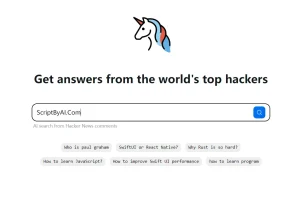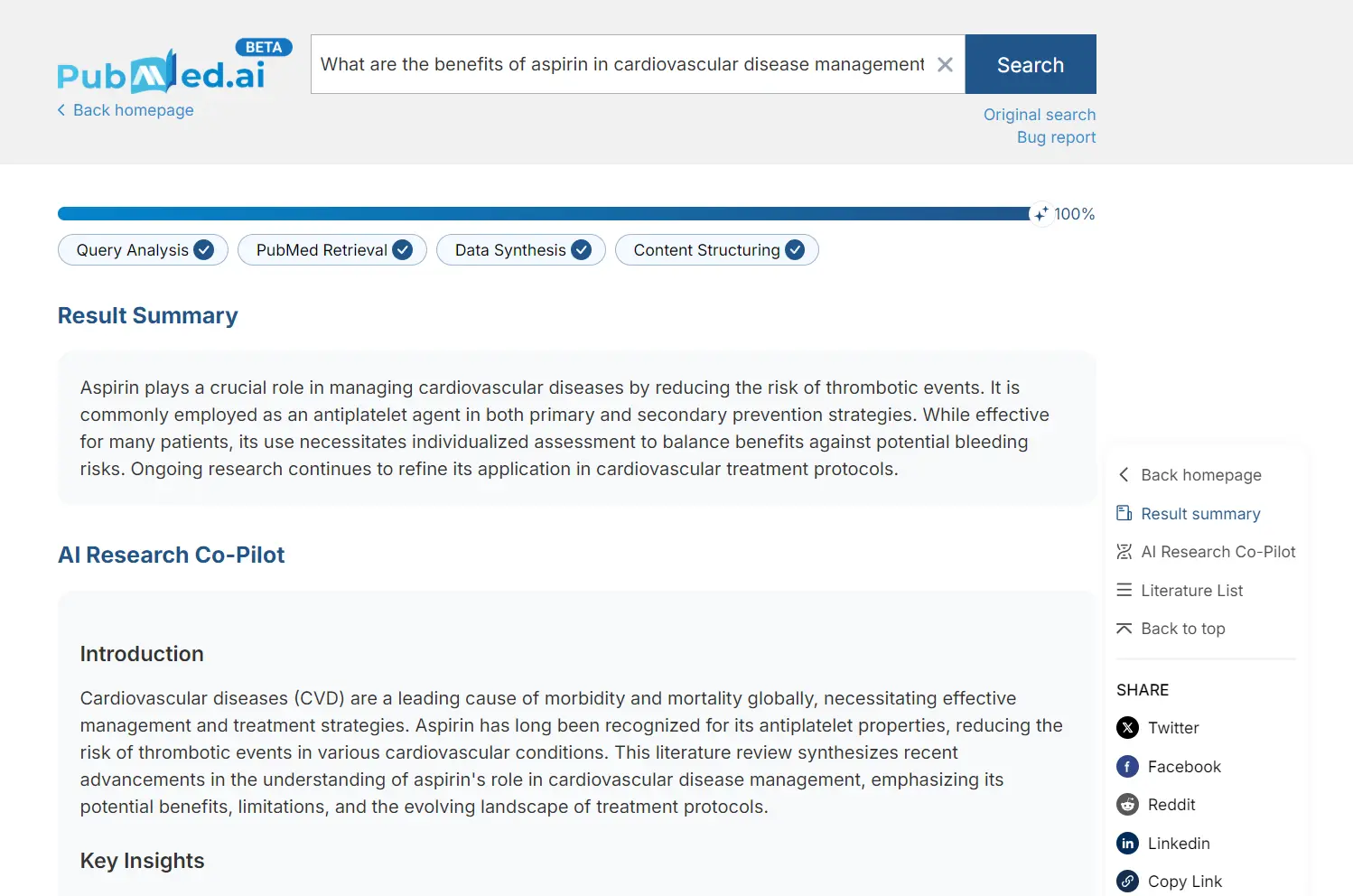
PubMed.ai is a free AI-powered retrieval tool that helps you find and understand biomedical literature. It connects to PubMed’s massive database but adds a layer of intelligence to make searching easier and more effective.
Most medical professionals know the frustration: PubMed contains incredible research, but finding what you need requires mastering MeSH terms, Boolean operators, and complex filters. PubMed.ai solves this by letting you search in natural language and get detailed research reports instead of endless paper lists.
Features
- AI-Enhanced Search: Query optimization turns natural language searches into precise results from PubMed’s database.
- Automated Research Reports: Generates PDF reports with key insights, methodologies, and conclusions.
- Conversational AI Assistant: Deep Chat for asking follow-up questions, clarifying medical terms, and exploring research implications.
- Evidence-Based Answers: All responses backed by current medical literature with proper citations.
- Literature Analysis: Deep analysis of search results to extract trends, key findings, and academic insights.
- Multiple Citation Formats: One-click downloads in established citation styles for academic writing.
- Real-Time Updates: Access to the latest medical findings as they’re published in PubMed.
Use Cases
- For Medical Students: Quickly get up to speed on a new topic for an essay or project. Instead of spending hours sifting through papers, you can get a summary of the latest findings and historical data to build from.
- For Biomedical Researchers: Streamline your literature reviews. Use the AI to identify key papers, extract data, and even help formulate a hypothesis for your next study. It helps you focus on the science, not the search.
- For Clinical Practitioners: Get quick, evidence-based answers to support your clinical decisions. When you need the latest research on a specific condition or treatment, PubMed.ai can provide diagnostic insights and treatment protocols backed by recent literature.
- For Medical Writers: Use it as an advanced writing assistant. The tool can help you refine your search intent through conversation, generating case studies, research summaries, or sample essays based on your queries.
How to Use It
1. Visit pubmed.ai and enter your research question in natural language. No need for complex MeSH terms or Boolean operators.
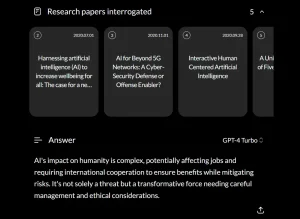
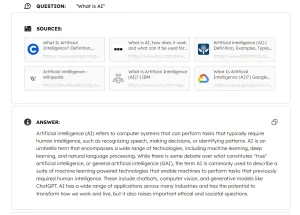
2. The AI analyzes relevant PubMed literature and generates a structured report including:
- Executive summary of key findings
- Detailed analysis with citations
- Methodology insights from reviewed studies
- Clinical or research implications
3. Browse the curated list of source papers used in the report. Each citation includes direct links to PubMed entries.
4. Ask follow-up questions in the deep chat interface on the right side:
- Request clarification on complex terms
- Explore specific aspects of your research topic
- Ask for additional studies or related research
- Get help with experimental design or data interpretation
5. Export your research report as a PDF and download properly formatted citations for your academic work.
Pros
- Time-Saving: Generates research reports in minutes instead of hours of manual searching.
- Accessible Interface: Natural language search eliminates need for technical PubMed expertise.
- Quality Citations: All sources come from PubMed’s peer-reviewed database with proper attribution.
- Comprehensive Analysis: AI extracts key insights and trends across multiple studies.
- Free Access: No subscription fees or usage limits for core features.
- Academic Integration: Professional citation formatting for research papers and publications.
- Real-Time Updates: Access to latest medical literature as it’s published.
- Multi-Format Export: PDF reports and citation downloads in various academic styles.
Cons
- Limited to PubMed: Only searches PubMed database, missing some specialized journals and grey literature.
- AI Interpretation: While accurate, AI analysis may miss nuanced clinical context that experienced researchers would catch.
- New Platform: Relatively new tool with smaller user community compared to established research platforms.
- English Focus: Primarily optimized for English-language medical literature.
Related Resources
- PubMed Official: pubmed.ncbi.nlm.nih.gov – The original biomedical literature database
- Cochrane Library: cochranelibrary.com – Systematic reviews and evidence-based medicine
- MeSH Database: meshb.nlm.nih.gov – Medical subject headings for advanced PubMed searches
- NCBI Literature Search Guide: ncbi.nlm.nih.gov/books/NBK3827 – Comprehensive PubMed search tutorials
- Evidence-Based Medicine Toolkit: cebm.ox.ac.uk – Resources for clinical evidence evaluation
FAQs
Q: How accurate is PubMed.ai compared to manual PubMed searches?
A: PubMed.ai uses the same authoritative PubMed database as manual searches but adds AI optimization for query refinement and result analysis. The tool often finds relevant papers that manual searches might miss due to its ability to understand context and related terms. However, the AI analysis should complement, not replace, critical thinking in research evaluation.
Q: Can I trust the AI-generated research reports for academic work?
A: The reports provide excellent starting points backed by peer-reviewed sources, but they should undergo the same critical evaluation as any research summary. All citations link directly to original PubMed papers, so you can verify findings independently. The tool excels at identifying relevant literature and extracting key points, but final interpretation should always involve human expertise.
Q: Is PubMed.ai suitable for clinical decision-making?
A: While PubMed.ai provides valuable evidence-based insights, it should support rather than replace clinical judgment. The tool helps clinicians quickly access relevant research, but patient care decisions must consider individual circumstances, clinical experience, and current guidelines. Think of it as a research assistant rather than a diagnostic tool.