N8N2MCP is a free open-source platform that transforms your existing n8n workflows into Model Context Protocol (MCP) servers that work with Claude, Cursor, and other AI assistants.
Traditional AI assistants are limited to their built-in functions, while your carefully crafted N8N workflows contain powerful automation logic that could supercharge AI capabilities.
N8N2MCP solves this disconnect by converting workflows into MCP servers that AI assistants can call as custom tools.
You get to keep using N8N’s visual workflow editor while extending your AI assistant’s capabilities with your own business logic.

The platform works through a dual architecture system: an Agent Marketplace for workflow management and deployment, plus an MCP Router that handles the actual server creation and routing.
Once deployed, your workflows become callable functions that AI assistants can use during conversations.
Features
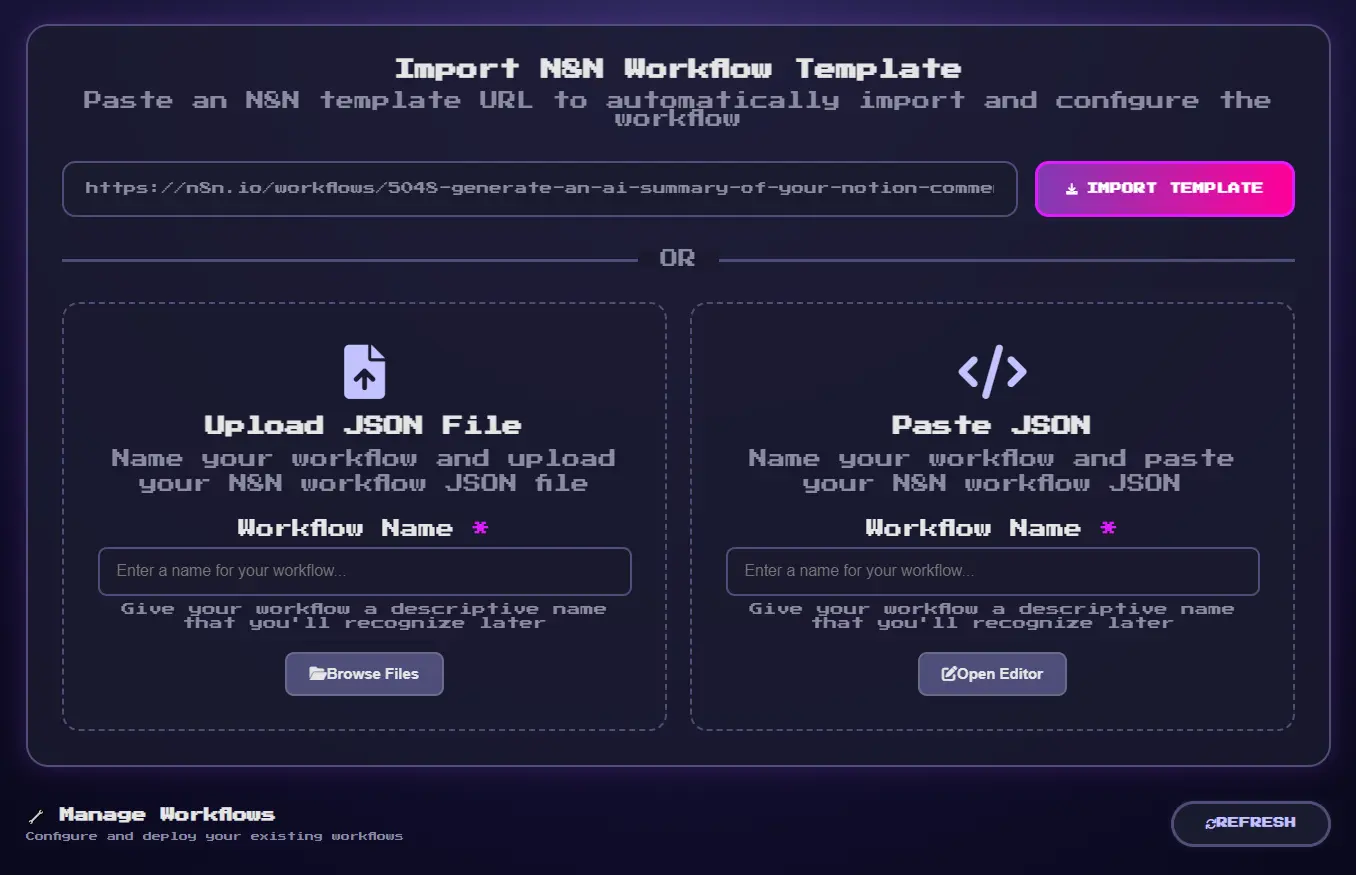
- 3-Click Conversion Process: Import N8N templates or upload custom workflows, map credentials through the interface, and deploy with one click.
- Dual Architecture System: Agent Marketplace (Flask web app) handles workflow management while MCP Router (FastAPI service) creates and routes MCP servers.
- Template Import Support: Browse and deploy pre-built workflow templates directly from n8n.io community templates.
- Custom Workflow Upload: Upload your own N8N workflow JSON files for conversion into MCP servers.
- Credential Management: Secure credential mapping through an intuitive interface with real-time configuration testing.
- Real-time Deployment: One-click deployment to your N8N instance with automatic MCP server endpoint generation.
- Multi-AI Assistant Support: Generated MCP servers work with Claude, Cursor, Super Chain, and any MCP-compatible platform.
- Open Source Architecture: Fully open-source with MIT license for transparency and customization.
How to Use It
1. Clone the repo from Github:
git clone https://github.com/Super-Chain/N8N2MCP.git
cd N8N2MCP
2. Install dependencies (requires Python 3.11+):
pip install -r requirements.txt3. Install Playwright
playwright install4. Set up environment variables:
cp .env.example .env# Copy this file to .env and update with your actual values
# Supabase Configuration
SUPABASE_URL=https://your-project-id.supabase.co
SUPABASE_KEY=your_supabase_anon_key
SUPABASE_SERVICE_KEY=your_supabase_service_role_key
# N8N Configuration (cloud.n8n.io or self-hosted)
X_N8N_API_KEY=your_n8n_api_key
N8N_BASE_URL=https://your-n8n-instance.com
N8N_USERNAME=your_n8n_username
N8N_PASSWORD=your_n8n_password
# MCP Router Configuration
N8N_BUILDER_URL=http://localhost:6545
# Server Configuration
FLASK_HOST=0.0.0.0
FLASK_PORT=5000
MCP_HOST=0.0.0.0
MCP_PORT=6545
# Optional: Authentication credentials (auto-populated by system)
N8N_AUTH=
N8N_BROWSER_ID=
5. Start the system. This boots both the Flask frontend (Agent Marketplace) on port 5000 and the FastAPI MCP Router on 6545.
python main.py6. Go to http://localhost:5000, paste a template ID or upload your N8N JSON. The tool analyzes which credentials your nodes need.
7. Fill in API keys for services like Slack, Google Sheets, etc. Click deploy. N8N2MCP creates the workflow in your N8N instance and generates an MCP endpoint.
8. Paste the MCP URL into Claude, Cursor, or any MCP clients.
http://localhost:6545/mcp/{workflow_id}/{api_key}Pros
- Open-Source: The entire tool is free and available on GitHub.
- No-Code Conversion: You don’t need to write any code to convert the workflow itself..
- Direct AI Integration: It creates a direct line between your automations and modern AI assistants.
- Self-Hosted: You control your data and infrastructure.
Cons
- Initial Setup Complexity: You need to handle Python environments, environment variables, and set up a Supabase project. This isn’t for absolute beginners.
- Requires Multiple Services: You need to manage an N8N instance and a Supabase project. This adds a few moving parts to the system.
- Self-Hosting Overhead: You have to keep the server running and secure.
Related Resources
- N8N Official Documentation: Comprehensive guide to creating workflows, node configurations, and automation best practices.
- Model Context Protocol Specification: Technical documentation for understanding MCP architecture and implementation details.
- Supabase Documentation: Database setup guides, authentication methods, and API reference for the backend storage system.
- FastAPI Documentation: Framework documentation for understanding the MCP Router architecture and customization options.
- Playwright Documentation: Browser automation guides for troubleshooting N8N authentication issues and headless deployment.
- Claude MCP Integration Guide: Official Anthropic documentation for integrating MCP servers with Claude.
- N8N Community Templates: Repository of pre-built workflows that can be imported and converted into MCP servers.
- GitHub Issues and Discussions: Community support, bug reports, and feature requests from other users.
- MCP Servers: A directory of curated & open-source Model Context Protocol servers.
FAQs
Q: Can N8N2MCP work with self-hosted N8N instances?
A: Yes, N8N2MCP supports both cloud.n8n.io and self-hosted N8N instances. You’ll need to configure the N8N_BASE_URL in your environment file to point to your self-hosted instance and ensure the API is accessible from where N8N2MCP is running.
Q: What happens if my N8N workflow requires credentials that aren’t supported?
A: N8N2MCP’s workflow parser analyzes your workflows and identifies required credentials automatically. If specific credential types aren’t recognized, you can manually configure them through the web interface or modify the credential extraction logic in the source code since it’s open source.
Q: Is there a limit to how many workflows I can convert?
A: N8N2MCP doesn’t impose artificial limits on workflow conversion. Practical limitations depend on your N8N instance’s capacity, Supabase database storage, and server resources running the MCP Router. Each converted workflow creates a unique MCP endpoint that AI assistants can call.
Q: What is the Model Context Protocol (MCP)?
A: The Model Context Protocol (MCP) is a standard that allows AI models to interact with external tools and functions in a structured way. Think of it as a language that lets an AI like Claude know what a tool does, what inputs it needs, and how to use it. N8N2MCP makes your N8N workflows speak this language. Learn More About MCP.