Jev is TypeSafe AI’s first public System One Model. It handles bounded judgments inside your workflows and returns typed decisions with probability and confidence data. The calling code supplies the state, defines the questions, and decides what to do with the result.
Jev exposes several decision types for different kinds of judgment. Choice selects from predefined options. Score evaluates something against an ordered scale. Noul estimates the probability that a statement is true. These outputs can feed into routing, ranking, filtering, approval rules, and other application logic.
Structured state → Choice / Score / Noul → probability and confidence → workflow action
For example, a browser agent can select its next control from the actions available on the page. A coding agent can score candidate context before deciding what to retain. Search pipelines can score relevance, inbox workflows can assign categories, and agent guardrails can estimate the risk of a proposed tool call.
The use cases below show how developers are using Jev for repeated decision loops, browser control, coding agents, reranking, classification, and safety checks.
Last updated Sep 20, 2026
Jev Use Cases at a Glance
| Use case | What Jev decides |
|---|---|
| Browser action selection | Next browser operation and target element |
| Real-time action selection | Next move from changing state |
| Coding agent context compaction | Which tool history should stay |
| Model, tool, and agent routing | Which capability should handle a task |
| Agent guardrails | Allow, review, or block an action |
| Batch classification | Category assignments across large collections |
| Search reranking | Relevance of candidate results |
| Content evaluation | Scores and attributes against defined criteria |
| Semantic filtering | Whether content matches a written rule |
| Structured-data decisions | Semantic judgments over database rows |
1. Browser Action Selection
Choice selects from known options. Score evaluates something against an ordered scale. Noul estimates whether a statement is true.
A browser agent can click the selected element. A coding agent can remove stale context. A router can choose a model or tool. A database query can use a semantic score to filter or sort rows.
Browser automation repeatedly needs to choose the next action from the current page state and task goal.
Jev Ultrafast converts interactive page elements into structured state. Jev selects an operation and target element. Browser code performs the action, observes the updated page, and submits that new state for the next decision.
Page controls + goal → choose action and element → browser executes → observe new page
Gregor Zunic’s Google Flights demo completed a Zürich-to-London search in about seven seconds at a stated cost of $0.0039. A small language model handles text when the selected operation requires typing.
Jev handles one bounded choice at each step. The browser observes the result before requesting another action.
The seven-second figure comes from one Google Flights run and should not be read as a general browser automation benchmark.
2. Real-Time Action Selection
A game creates a repeated decision loop: each action changes the state before Jev makes the next choice.
TypeSafe founder Diogo Almeida’s Doom demo feeds game state into Jev and applies the selected action. The demonstration ran at roughly ten Jev calls per second.
Faadil Shaik’s Super Mario Bros. project supplies structured information about movement, enemies, terrain, and recent actions. Jev selects a controller action. The emulator advances the game and returns an updated state for another decision.
Game state → choose controller action → emulator advances → updated game state
Both demos use the same loop: select one action from a bounded set, apply it, observe the new state, and make another decision.
3. Coding Agent Context Compaction
Long coding-agent sessions accumulate shell output, file contents, search results, and other tool history. Older records can consume context long after they stop helping with the current task.
fast-jev-compaction uses Jev to judge the relevance of tool calls and their results. Local rules keep, truncate, or remove individual records based on those judgments.
Tool history → retention judgments → keep, truncate, or remove
Retained material stays verbatim, including file names, commands, and error messages. Recent records receive additional protection, and the Claude Code plugin can fall back to built-in compaction.
Jev decides which records deserve context space. The coding agent controls what gets removed and how much original text survives.
4. Model, Tool, and Agent Routing
AI agents can have several models, skills, tools, MCP servers, and subagents available at the same time. Selecting the appropriate capability becomes a bounded routing decision.
JevRouter converts available models, subagents, skills, MCP tools, CLIs, and plugins into a candidate set. Jev answers a typed Choice question. The router applies its permissions and policy checks before execution.
Task + available capabilities → choose candidate → policy checks → agent executes
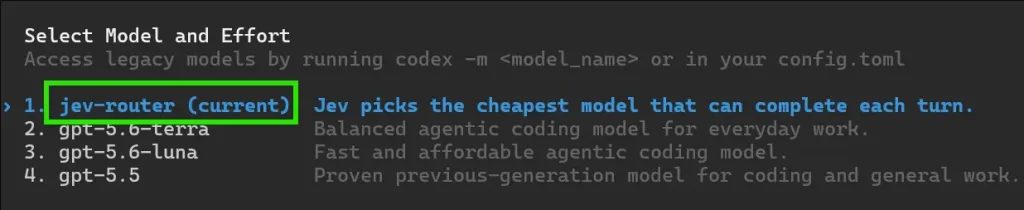
Jev-router applies a narrower version of the idea to model selection in Claude Code and OpenAI Codex. A new turn is classified and sent to the configured model tier for that type of work.
The agent already knows which choices are available. Jev selects among them. Permissions, confirmation requirements, and execution stay under local control.
5. Agent Guardrails and Risk Screening
An agent can require an additional judgment before a tool call runs: execute automatically, request approval, or block the action.
jev-guard evaluates coding-agent tool calls together with session context and maps the result to allow, ask, or deny. Returned tool content can also be screened for prompt-injection risk.
Tool call + session context → risk judgment → allow, ask, or deny
The project works with all major AI coding agents, including Claude Code, Codex, Copilot CLI, Gemini CLI, and Cursor.
Jev provides the risk judgment. Hard permissions and confirmation rules continue to control access to files, shell commands, credentials, and external accounts.
6. Batch Classification and Organization
Classification maps naturally to typed decisions because the possible categories are known before each request runs.
Riley Brown’s email demo classified 500 messages in seconds at a stated cost of 3.5 cents.
A research-paper experiment classified 1,018 AI papers across 24 possible topics. DeepSeek V4 Flash generated summaries first. Jev received each title, summary, and set of topic options.
The Jev classification portion cost a stated $0.08, with a median latency of 256 milliseconds per paper. Summary generation cost an additional $3.99.
Item + known categories → select category → store or review label
The email and research-paper examples apply the same decision shape to very different collections.
A confidence threshold can send uncertain results to review. Ambiguous emails can stay in the inbox, and research papers can retain their previous labels until someone checks the new classification.
7. Search Reranking and Relevance Scoring
Search pipelines often retrieve more candidates than they want to present. A second evaluation stage can judge how closely each result matches the request.
Jev Search uses Jev to help choose search sources, query terms, and a time range. Jev also scores returned results for relevance.
Search request → choose search strategy → retrieve candidates → score relevance → reorder results
Search engines perform the retrieval. Jev handles decisions around search strategy and candidate relevance.
A similar setup can work wherever a known set of candidates needs semantic relevance scores, including document search, knowledge bases, and recommendation systems.

8. Content Evaluation and Scoring
Jev can apply predefined criteria across a large collection of existing content.
Matthew Berman’s ad experiment processed 724 ads from 37 brands. The evaluation included hooks, formats, offers, calls to action, awareness stages, and mismatches between ads and landing pages. The stated run took about 40 seconds and nine cents in token costs.
Ian Nuttall applied 8 questions to 3,282 of his X posts to examine attributes such as topic, hook, tone, and instructional content.
Content + evaluation criteria → scores or labels → compare, flag, or analyze
For an ad library, those judgments can help group or compare creative patterns. Writing checks can flag passages for review. Social-post labels can reveal patterns across an existing archive.
9. Semantic Filtering and Detection
Some filtering rules depend on meaning that a fixed keyword list cannot capture reliably.
Marcel Pociot’s X extension demo hides or collapses posts that match natural-language filtering rules.
Post + written rule → match judgment → show, collapse, or hide
Tony Dinh’s Sponsor Skip demo applies a similar decision to YouTube transcripts. The Sponsor Skip implementation examines caption text or transcribed speech, identifies sponsor passages, maps them to timestamps, and controls playback.
Transcript segment → sponsor judgment → map to timestamp → skip segment
Audio modes use Deepgram for transcription before Jev evaluates the resulting text.
Both examples use reversible actions. A hidden post can be restored, and playback can be moved back when a skip includes regular video content.
10. Natural-Language Decisions Over Structured Data
Jev decisions can also run inside a database query.
pg-jev is a PostgreSQL extension that evaluates rows with Jev. SQL queries can classify, score, rank, or filter records using semantic conditions.
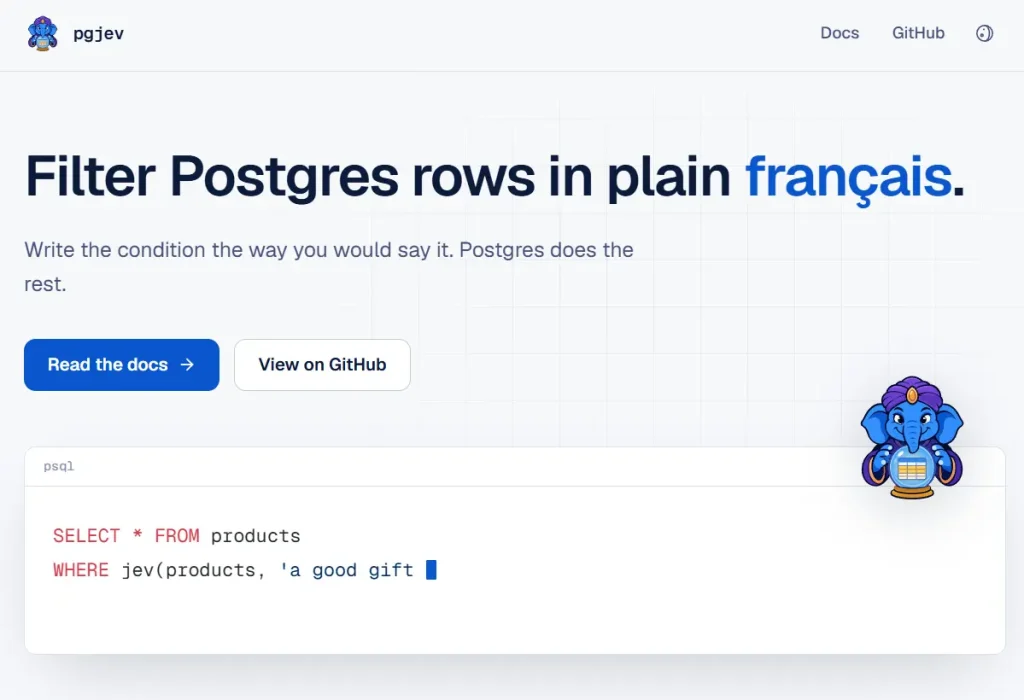
Examples include identifying the tone of a support ticket, choosing which team should handle it, or scoring products against an ordered criterion.
Database row + semantic condition → Choice / Score / Noul → SQL filter, group, or sort
The extension batches rows into shared Jev requests and exposes the results through SQL functions.
Probabilities can participate directly in filters and sorting. Categorical answers can feed grouping, reporting, or business rules without requiring a separate agent layer.
Where Jev Becomes Useful
Across these examples, Jev tends to appear at one specific point in a larger system: a small judgment that needs to happen repeatedly.
A browser agent needs to choose its next control. A coding agent can score candidate context and retain the items that meet its selection criteria. A search pipeline needs relevance scores. An inbox needs categories. An agent needs a risk judgment before a sensitive tool call.
These tasks already have boundaries. The calling code defines the available actions, labels, scoring criteria, or statements before sending the request. Jev returns a typed judgment that the software can use to click an element, retain a record, rerank a result, request approval, or flag an item for review.
That is a useful way to think about Jev when looking at your own project. A good candidate is usually a recurring judgment with clear input, a bounded answer, and an outcome you can check afterward.
Confidence becomes especially useful when there is an easy fallback. An uncertain email can stay untouched. A risky tool call can ask for approval. A weak relevance score can leave the current ranking alone. A browser agent can inspect the page again before choosing another action.
The examples above also show that Jev does not need to control an entire system to be useful. In many of the strongest demos, it handles one narrow decision inside code that already knows what to do with the answer.
FAQs
What kinds of tasks is Jev currently being used for?
The examples above use Jev for browser actions, model and tool routing, agent guardrails, context compaction, classification, search reranking, content scoring, semantic filtering, game actions, and database-row judgments.
Which tasks map most naturally to Jev’s decision primitives?
Tasks with predefined choices, ordered scores, or statements that need a probability estimate map directly to Choice, Score, and Noul. Current examples include classification, routing, ranking, filtering, screening, and action selection.
Can Jev run an agent on its own?
Jev handles bounded decisions inside an agent or automation workflow. The agent code manages state, tools, permissions, execution, retries, and fallback behavior.
How should a workflow use Jev confidence scores?
Confidence thresholds can control when an action runs automatically, goes to review, or stays unchanged. The right threshold depends on the decision and the results you observe on representative inputs.
Are all of these examples from TypeSafe?
No. Some come from TypeSafe, while others come from developers experimenting with Jev in their own projects, extensions, agents, and demos.
Related Resources
- Jev Resource List: SDKs, MCP servers, integrations, benchmarks, examples, and additional Jev projects.
- Claude Code Resource List: Agents, skills, plugins, and developer resources for Claude Code.
- Codex Resource List: Skills, plugins, MCP resources, SDKs, and Codex projects.